“It was November of 2020,” Rose says across the low timber coffee table between us. The late morning sun is creeping through the back-alley Eucalyptus trees and into the Youthy attic.
“I was walking along Franklyn Street. The wind and the leaves were swirling. I picked up a piece of paper and it was my home of 20 years, my garden of 20 years turned into a cafe with umbrellas all along Franklin Street. That’s how we found out that they planned to demolish the estate and put up to 14 storey high apartment blocks.”
The flier that Rose describes was a discarded copy of the NSW State Government’s Franklyn Street Glebe Redevelopment Proposal. The front page featured a digital projection of what was being proposed. It showed footpaths bustling with pedestrians, vibrant greenery, and several orange umbrellas of a street corner cafe. This was a graphic designer’s interpretation of the proposed changes; a view of what the future could hold for the residents of Franklin Street and broader Glebe. Notably out of view, however, were the downsized dwellings that were to be built in replacement that would force families to look elsewhere. The image didn’t show all of those tenants who would likely never return after the total upending of their lives. Nor could you see the transfer of public property into private hands—the losses to our commonwealth. It is, after all, quite difficult to envision what’s no longer there.
As Rose reflects now—nearly five years since she first came across that A4 printed obscurity of her home—there’s a heaviness in her eyes; voice lowered by a lingering anvil of injustice. She’s clearly still affected by that day and the events that came after, that threw into disarray a community she has long held close to her heart.
“There’s only six people in our apartment block. And because they’re all one bedroom, it’s not families. It’s all single people. Edwina is on the top floor. I’m on the bottom”.
Edwina sits comfortably across from me, along-side her longtime friend a neighbour.
“I’ve lived there like 11 years.’ she says. ‘But I’ve actually lived in Glebe probably 15, 16 years or higher.”
Edwina knows all too well the unpredictability of the state housing system. For much of her life she has been thrown by the waves of poverty, racism, and the traumas that followed—into the burrows of drug addiction, and in more recent years, out onto the streets of her neighbourhood alongside friends and neighbours in a collective struggle for the basic human right of a solid roof over their heads.
Edwina is a Māori woman, having ventured from Autoera in … as a young woman in search for new beginnings.
“I came to Sydney to be myself because I wanted a new life. And I got it … I managed to go to TAFE, graduate, went on to work for Qantas, and then went on to work in packaging. It took me bloody years because I’ve had to fight for everything I’ve got. I was one of the first people who was approached by ACON to work for them (A leading community health organisation in NSW since the 1980s, focusing on social inclusion and HIV responses). I did volunteer work for Sex Workers Outreach Project and worked for them for many, many years. That was my community service giving back … At the time, I was very naive, very young, very stupid. I didn’t know what I was talking about. I had friends tell me, get away from whoever you’re hanging around with. Tell them to go away. They’re just wrecking your life. I was young, pretty. I could have had any boyfriend I wanted at the time. But as you get older, those things don’t matter as much. All you think about is your home, your security, your welfare.”
Before living on Franklyn Street, Edwina was shuffled through various housing estates of Inner-Sydney. She had once lived down on Cowper Street, along the outskirts of Wentworth Park.
“I loved it,” she says, ‘because it’s so close to everything. I was working for Qantas. I was on my push bike. I was fit. I got to travel. I went to Bali. I went to Nepal. I did all these wonderful, great things.”
However, this fitting situation was cut short when the Kenneally State Government decided to sell off most of the land to private developers for them to eraect their fortunes. Not only were the residents evicted, but the land lay vacant for four years before the construction of new dwellings began on the remaining slice of public land. It was around this time that Edwina found a home within the Franklyn Street community she still proudly works to protect.
“It’s a very supportive community.” Rose says, “I broke my leg in the first lockdown. I stayed with someone and then Edwina helped. I felt like I joined a Māori family. I woke up one day and Edwina was sitting there with a coffee and came in to take the garbage out.
“I think being Māori,” Edwina adds, “you have a much more sense of connection, looking after people. Community.”
Rose has lived on Franklyn Street for twenty-five years and is no stranger to the difficulties in dealing with the state housing system.
“We already had done some protesting about 15 years ago. I and a couple of neighbours put gates on our estate. Because as tenants, we knew the kids, not just local kids, but other kids were running through the estate away from the cops, because there were six or seven ways out and no car access. So, they’d run from the cops. The police called it The Rabbit Warren. They came back one day and ripped all the greenery out, every hedge, so no kid could hide behind it, like overkill. So we put the gates on, and the crime rate on our street dropped by 95% overnight. So, its actually people doing the work, connecting to each other. And some of the gates are not functioning anymore. And I did hear from someone that housing wants to take the gates down to create a community ground. And I was already warned when we did this that these things are cyclical, they’ll come up again.”
But this friendly warning from her community could in no way prepare Rose for the shock of that now infamous image, plucked from the concrete just after the Covid-19 lockdown in late 2020.
“It was so shocking because we’d just been through the first lockdown, and people’s mental health issues…so many people. We had the isolation of the pandemic, and no services for anyone. And they got an eviction notice just before Christmas, after the lockdown, because they don’t care. They don’t care … And the only way we could give our point of view, was that online Zoom meeting. We were only allowed to write things, and they selected what they read out. And they said, they’re going to give us a park and a community. ‘It’s going to be really nice’. Most of us would say, ‘we have a park and we have a community. The money we save each other when someone’s sick or needing mental health support, or just navel illness, we have a community.’”
What came next provides a glimpse into the unique strength of this community: hundreds of tenants, neighbours, students and legacy activists entered the surrounding streets in a collective outcry towards the State Governments immoral and seemingly ill thought actions. Many held banners, waved flags of working-class unity, and chanted phrases that echoed through the yards and alleyways of Glebe’s east end.
“We pounced immediately; we called a rally” says Hannah Middleton in late 2024. She is sitting upright in her bed on an upper level of Balmain hospital. Alongside her sits Denis Doherty. Both have been prominent, active members of Hands-off Glebe for over a decade.
“We first met in a group set up in Sydney to oppose the US military bases in Australia. We had a shared social justice commitment.”
Throughout the 1990s, the pair noticed a shift in the political climate; the face of their beloved suburb being transformed.
“We noticed that Glebe was about to face change: buildings were being torn down, horrible little boxes were being erected.”
Throughout the next few decades, they would remain involved in various movements, pushing back against the increasing developments that continued to plague the suburb, especially its more vulnerable cohorts.
The coordinated response to the Franklyn Street Redevelopment Proposal was informed by years of experience, friendships new and old; from past successes, and lessons learnt from inevitable missteps along the way. When representing the interests of more vulnerable groups, such as those living at the Franklyn Estate, Denis says that “there’s a responsibility to make sure that you’ve got enough connections into the tenant group to be fairly certain you know what they were thinking. The experience usually was that they didn’t want to move because the local shopkeepers knew what they wanted in the shopping bag. They knew where their doctors were. They knew if it was really hot or really cold, they could go down to Broadway Shopping Centre and they could hang out there because there are places you can sit. They have all these things, and they know their network. And so, for many of them, moving was very traumatic.”
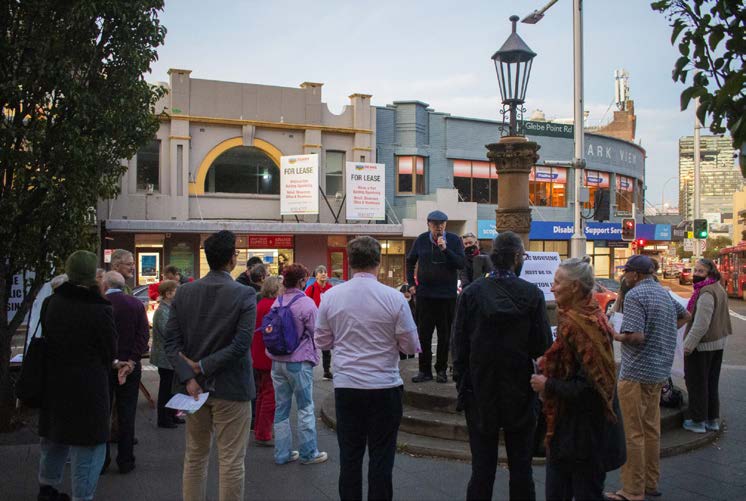
In describing the initial protest, Hannah says, “they allowed us to walk from the little park across from Badde Manors to Franklin Street. it was quite a remarkable event. We got maybe 300 or 400 people. And we had sort of all sorts of people coming out of the woodwork, people that we hadn’t really worked with before. There was Hands Off Glebe, we had the Anglican Church at St. John’s putting a sign up, saying we support public housing. We had a faction of Young Labor, the Congress Party and the Socialist Alliance.”
The resistance continued throughout the next few years, as tenants remained in a state of limbo, yet still vigorous in their defence. On the 22nd of February 2023, Hands Off Glebe, with support by the Glebe Society launched The Franklyn Report at Sydney Town Hall. The report vehemently rejected “the NSW Government’s demolition and redevelopment plan, calling instead for maintenance, renovation and reuse of the solid brick flats on the site.”
It outlined in great detail how the proposed redevelopment “would result in adverse outcomes for the community, the environment, heritage and the government’s own stated policy aim of increasing public housing,” and that redevelopments “would actually reduce the number of public housing places by reducing the total number of bedrooms”.
“The most irritating or angering thing was that they weren’t revolutionary, billion dollar things. They were small, simple, common-sense, improvements that people shouldn’t have to ask for.”
As for the sentiments echoed throughout its pages, Hannah Middleton explains, “a lot of the pushback from the community was: ‘we’re not going to have enough sunlight, it’s going to reduce our open space, we’re not going to have as many gardens’. Things like how much sunlight you should be able to get are actually already included in building codes. It’s nothing new. But in talking with people on the estate, and because this had been built by the government, it became clearer that they’d actually they’d broken their own rules. And people were very clear about what they wanted. The most irritating or angering thing was that they weren’t revolutionary, billion-dollar things. They were small, simple, common-sense, small improvements that people shouldn’t have to ask for.”
“The report was something that Ian Stephenson did for us,” Rose says. Ian Stephenson was an integral member of The Glebe Society in recent years, president since 2020, and a well-loved figure of the community.
“He was just such a friendly, supportive person.”
Ian passed away in October last year, yet his legacy thrives through Glebe’s resilient spirit and the ongoing protection of its people and historical structures that he tirelessly worked to protect. His dear friend and fellow member of The Glebe Society, Duncan Leys wrote in late 2024: ‘The Glebe Society has lost not only a skilled, passionate and effective advocate but a wonderful human being.” The rigorous effort put into The Franklyn Report, and its ultimate success, embody a lasting symbol of his character and legacy.
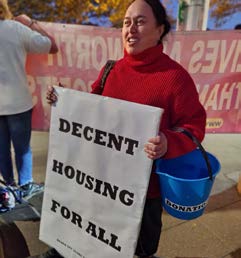
On the 13th of May, 2023 a decision was passed by the City of Sydney Council to reject the proposed redevelopment of Franklyn Street. Council members formally congratulated “Hands off Glebe and The Glebe Society for publishing the Franklyn Report, highlighting the inequalities of current government policy, and facilitating a platform for public housing tenants to have a voice.” The Council recognised “the courage, endurance and strong social bonds of public housing residents residing in the Franklyn Street public housing complex.”
The decision to accept recommendations of The Report was a testament to the efforts of all those mentioned above, and so many more integral figures of the movement and tenants of Franklyn Street. It also coincided with Gladys Berijiklians’ departure from office which alludes to the influence of the broader political climate, and relief from the Liberal party’s corporatist politics. This article provides a mere snapshot into a community of vital figures without which the successes described above would have been far less certain.
Whilst the decision marked an end to one inspiring yet traumatic chapter for tenants, it in no way puts an end to the ongoing struggle for basic welfare in Glebe and across the country.
“When they decided not to demolish, there was this idea of in-building,” Rose says, “but it doesn’t look like they’ll do it for a couple of years. There was hardly any restoration of the building. We don’t know if they’re coming back for this. You cannot get anything bloody fixed. If there’s graffiti, they’ll come and get rid of it the next day. And they always say it’s a different bucket of money. They don’t want the estate to look like a slum, but they don’t particularly care how people are living. They just care about cleaning up the outside of the state—like putting lipstick on.”
The United Nations’ Special Rapporteur on the right to adequate housing states that housing is “increasingly viewed as a commodity,” however it “is most importantly a human right. Under international law, to be adequately housed means having secure tenure—not having to worry about being evicted or having your home or lands taken away.” And so, but based on the nation’s international obligations, the actions of the State Government described here are not only glaringly immoral, but are in fact illegal. The continued neglect of these obligations further poisons a sense of trust one might have in our government institutions, especially when the consequences are most harshly felt by those already doing it tough.