
A black and chrome coloured motorbike with a large headlight travels down Glebe Point Road. Hilik rests upon the noticeably altered vehicle, wearing beige workpants, leather boots and prescription glasses. Attached to the bike’s rear are two parallel grinding wheels—levered to what looks like the engine of a lawnmower. Steel boxes hang off the bike’s frame for additional storage. Hilik veers right onto Mitchell Street and out of sight.
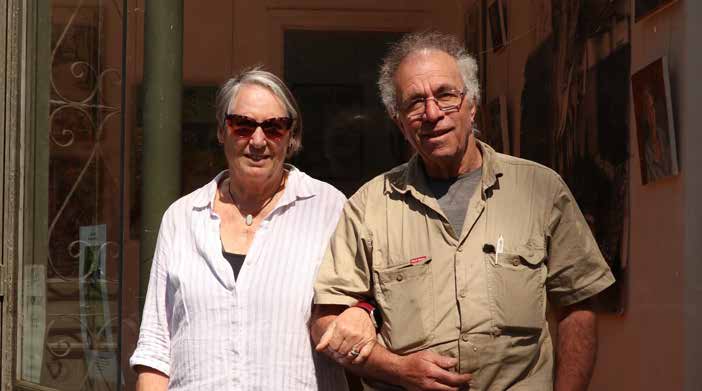
A few minutes later, Anna reverse parks her white hatchback into an empty space directly outside 112 Glebe Point Rd— Otherwise known as The Shop Gallery. She exits the vehicle before opening the gallery door to a spacious room, well-lit by the morning Winter sun. Upon entering, both Anna and Hilik offer me a homely welcome. It feels like walking into a cloud before the warm tones of dusk take hold. The bare white walls and dangling vacant hooks emit an aura of looming imagination—an urban blank canvas to be interpreted and reinterpreted across time and space. Looking back out to the street, you can see a window-framed snapshot of this suburb in gradual motion— characters passing across the pavement like the steady hands of a clock: time marches forward, the youth grow too big for their bicycles, businesses come-and-go; this suburb inevitably changes, but at a tempo that suggests permanency.
Anna reflects this outward gaze in her poem, The Street.
the sun is blazing through the gallery window
we talk in the shade near the wall
the artist prefers to sit on the floor
young parents walk past with toddlers
to the pre-school kindergarten down the road
the garbos drop by for a coffee across the road
and empty the street bins on the way
a spiky seed falls from a street tree
a couple of kids jigging school
come downhill
one on a skate board
the other racing behind
the guy with the straw hat walks past, waves
from the outside
taking photos
the reflection of clouds is superimposed
over the open bird cage
the artist’s hats are visible in the mirror
Anna Couani and Hilik Mirankar opened The Shop Gallery in December of 2014 as a space to share the vast spectrum of creative works emerging from within Glebe and beyond; from emerging artists seeking an accessible outlet, to those more established revisiting or reimagining their legacies. Hiring fees are kept cheap for artists. For those wishing to utilise the space, “it’s still a few hundred bucks,” Hilik says, “but it’s relatively cheap. Affordable, yeah. It’s not commercial rent”.
“We don’t make any money out of it,” Anna says.
Behind the exhibition space extends a long, two-storey warehouse. The bottom floor is filled with wooden sculptures: Hilik’s personal archive of timber expressions; shaped by the tools of curiosity, selfdiscipline, and fifty years’ experience. And then there are of course, the tools: an army of steel objects spread across the walls and benches—the little henchmen of a well-governed kingdom.
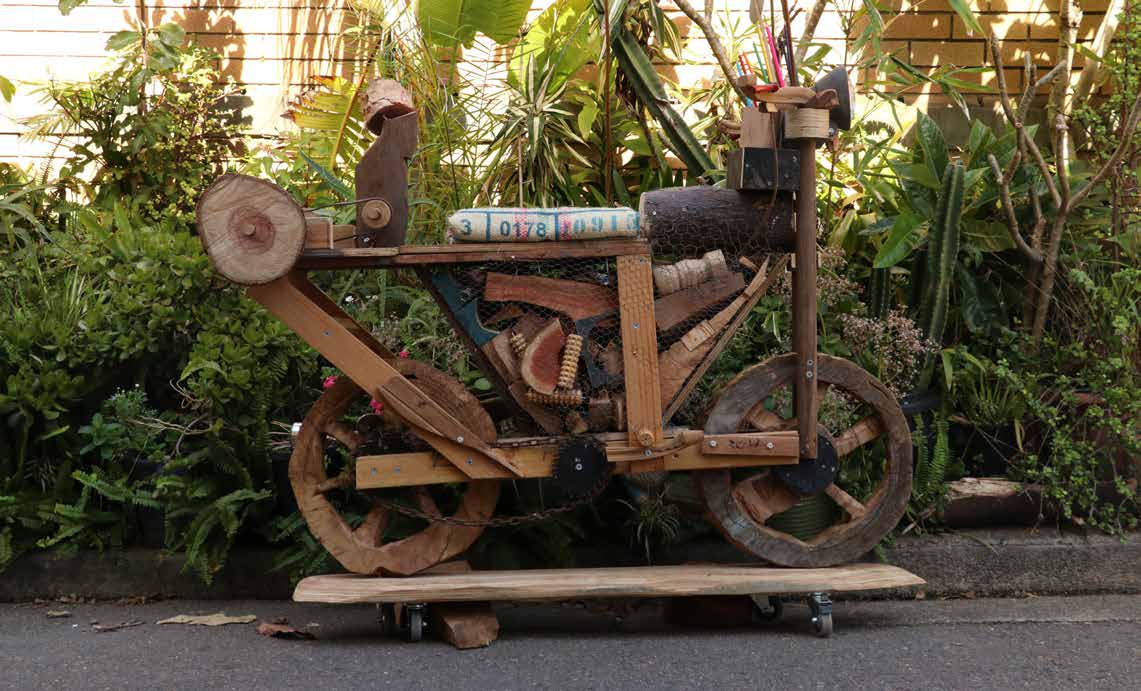
There’s a youthful energy in how Hilik discusses his almost lifelong practice. He says that his creative process is “very self-directed. I keep sculpting all the time. Sometimes it’s more fluent than others. It’s ongoing. And sculpture is an activity that requires a lot of work. I will make sure that the tools are in good condition. The space is well organised, and the truck is running properly, and the crane is working and all the other things that relate to sculpture.” As to how he approaches each new project, he says “there are different modes of working. The motorbike that I’m sculpting now…. it’s a combination of construction and carving. The wheels are carvings”.
The bike he refers to is a replica of the one seen earlier cruising down Glebe Point Road. It is recognisable to many throughout this city. The wheels attached to the bike’s rear have sharpened the knives of countless chefs throughout the city for decades—a door-to-door service that has been Hilik’s main occupation alongside his passion for sculpting.
“He finds logs everywhere,” Anna, his wife of 39 years adds, “especially after big storms. There’s wood everywhere. He sliced those logs into circular shapes, and then he started making wheels”. “I’m in this stage of my life now that I’m just about to stop sharpening,” Hilik says, “I’ve been doing it for 47 years. It might happen tomorrow.”
“That particular motorbike, symbolises for me the end of sharpening. It’s like something to put on my grave, you know?” Hilik jokes.
We now sit on the second floor above the gallery space, surrounded by various sketches, prints, paintings, sheet music, an electric piano, books, journals, anthologies: the various means and ends of Anna’s imagination that has cast an ever-widening net throughout her life.
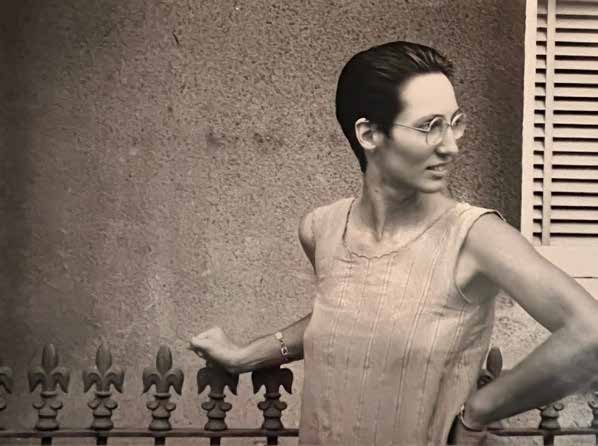
Anna lived with her family in Surry Hills during the 1960s before eventually moving to Glebe in 1971. By then she had reached early adulthood—a painter and student of architecture at the University of Sydney arriving upon the doorstep of Glebe’s radical era. She quickly became immersed within a generation of students, activists and creatives inhabiting the decrepit houses that sheltered a fast-growing community. One that was eager to reshape culture in lasting and socially conscious ways.
Anna portrays this formative moment of her life in the poem below:
The Old Mansion
The first place I lived in Glebe in the 70’s
was a couple of rented rooms
in a crumbling waterfront mansion
a bay window in a big room
overlooking The Harbour Lighterage Company
with their fleet of tugboats
that chugged home in the evening
twinkling lights under the stars
an industrial scene in miniature
with their cranes and slip rails
I remember my parents
mother shedding a tear
at the state of the walls
that she would become immune to
eventually
after visiting so many more of the same
down the years
vintage Glebe
the land sloped all the way to the water
without a fence
at the water’s edge in the shallows
was a small beach
and walking into the water
the brown mud squelched between your toes
seemed saturated with grease
embedded with shards of civilisation
sharp things

today the waterfront walk has claimed a slice
of waterfront land
from the end of the bay winding around
to the busy highway
beautifully landscaped Council initiative
I stand at the water looking up at the old mansion
at its bay window
at the still unpainted derelict walls
just as they were 45 years ago
now the slope to the water
once dry and bare
is jungle
the big Harbour Lighterage crane
now an arch over the path
historical remnant
Soon later, Anna developed a friendship with her university tutor Ken Bolton, who eventually became her partner of four years. Their relationship grew within a simmering local scene of creative writers.
“I met a group of poets that would get together and read each other’s work. And there were all sorts of interesting people coming in. I had been writing a bit before that, but not in any kind of public way. And so I sort of ditched painting for a while and became a writer. We (Anna and her partner Ken) began publishing this magazine called Magic Sam, and a book series called Sea Cruise Books. We used to go up to Sydney Uni and run it off their Roneo machines (hand operated stencil machines used for duplicating documents). And we’d go to the Tin Sheds to do the silkscreen covers…and Tomato Press, which was in Glebe, to do the stapling. And we had these wraparound silkscreen covers.”
Anna later published anthologies of short fiction alongside Damien White and Tom Thompson, collections that pushed the written word into unexplored territories.
“It was (at the time) mostly just the novel. There wasn’t…I called it experimental prose.”
As an emerging female writer of the 1970s, the weight of misogyny was a constant burden: “there was this big schism in the writing scene because the men couldn’t tolerate this idea of a women’s writers’ group. There were certain kinds of Jack Kerouac type of men: male writers who were On The Road kind of tough guys.” As a direct response to this, Anna and a group of women from the Poets Union formed the women’s writers group No Regrets.
No Regrets operated on a monthly basis for twelve years, throughout which writers would meet, present their work, and openly workshop ideas. Throughout this time, No Regrets would publish three anthologies of their own work.
In 1986, Anna walked through the doors of an old industrial warehouse at 2 Kelly Street, Ultimo—just 100 metres down the road from her home. Part of the councilowned building had been converted into a spacious art-gallery known as The Kelly Street Kolektiv—sheltering around 100 artists to create and exhibit their work. It was here that Anna would soon meet the gallery’s founder and form a decades-long bond.
“We operated there for two years,” Hilik says, “and many other art studios emerged in the building. It was like a hive of artists. And it just snowballed. People kept hearing about it. More people would come in. I lived there. And after a while, there was another group of artists that took the floor below me”. The crew downstairs became known as The Ultimo Project, which remains active to this day at the Addison Road Community Centre in Marrickville.
In a 2017 essay for The Sydney Review of Books, Anna recalls this critical juncture in her life:
“I heard about an artist-run collective gallery across the Glebe/Ultimo boundary called the Kelly Street Kolektiv, housed in the old warehouse that is now the International Grammar School. A few friends said, ‘There’s this amazing guy called Hilik (Mirankar), you’ve got to meet him!’ The Kelly Street Kolektiv was a revelation at the time. It had similar ideas to the Poets Union, promoting practitioners independently of the mainstream art structures, with the same internal conflicts about independence. The Kolektiv policy: We accept anyone who calls themselves an artist.”
The ethos of Kelly Street Kolektiv—the non-discriminatory acceptance of any selfidentifying artist— seems to have anchored the approaches of both Hilik and Anna in the decades since. The Shop Gallery carries forward this sense of openness and accessibility for artists from across the suburb, the city—this vast country. Just around the corner on Queen Street, Hilik’s wooden sculptures adorn the front porches of around a dozen terrace houses. For almost 25 years this public exhibition has become the beloved feature of a street framed by the sandstone walls and iron lace of old Glebe. Each sculpture carries a distinct personality— never imposing on what was long already there but revitalising the raw beauty of Glebe’s collective memory.
Anna and Hilik share a commitment of passing down their knowledge and experience to emerging generations of writers and artisans alike. From 1972 to 2016, Anna was a high-school art teacher. She also taught English to ESL students throughout this time, eventually publishing ESL training booklets for the NSW Department of Education.
More recently, Hilik has been sharing the techniques of his beloved craft, to “two girls who want to learn about sculpture.”
They don’t work as apprentices where I give them jobs to do,” he says, “they do their own work… it’s more of a mentorship”.
“One of them turned up here at the gallery,” Anna adds, “and asked to have a book launch because she’s a poet. It was about 18 months ago, and she saw Hilik’s studio. And then came back and asked him if she could work with him here. But then Hilik met someone at the market where he does knife sharpening. And she got talking to him and now she’s been whittling things. She started coming and she met Hilik’s other student. And it turns out they’re both poets.”
Whether through the No Regrets women’s writers’ group, Kelly Street Kolektiv, their educational pursuits, The Shop Gallery, or the various other initiatives they have supported, Anna & Hilik have nurtured spaces that allow disciplines to converge, correspond, and connect people through streams of mutual inspiration. Their combined histories show how art transcends the individual and strengthens communities upon the foundations of our shared vulnerabilities; through the collective empathy that emerges thereafter.
“Glebe has always been radical. I’ve always seen Glebe as an incubator,” Anna says before we part ways. I exit back through the front gallery space, out onto the footpath before waving Anna & Hilik goodbye, glance up and down Glebe Point Road while considering how this suburb has been a cultural incubator for countless writers, musicians, painters, wanderers, workers, thinkers and fighters. While Glebe’s radical era might now rest upon the pages of history, its spirit survives upon the walls of The Shop Gallery. Its front window reflects a suburb whose gutters have long flowed poetic streams—the salt tears of private pains and sweat-drops fallen from the pores of progressive struggles.
French author Albert Camus once wrote that art is the greatest “advocate of the living creature, because it is alive.” He believed that the artist “truly argues for love of one’s neighbour”. The Shop Gallery and those inside of it reflect this idea, of how the freedom to express is also the freedom to grow—to entangle one’s branches with those around us in a mutual ascent towards the clouds that await our collective flourishing.
The poems of Anna Couani included above are all extracted from her collection titled Local. It can be purchased from her website.