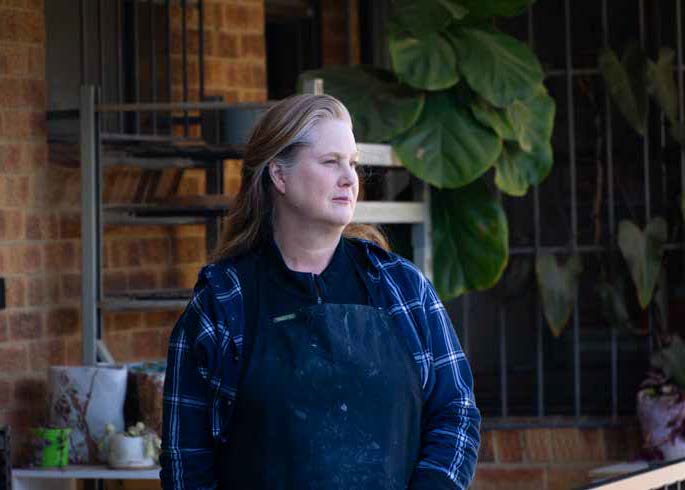
Kirsty Collins’ Auslan ceramics art club has become a space in which experimenting with clay has brought together an often forgotten community. While only up and running for the past three months, the workshop has flourished into a creative hub for deaf and hard of hearing people.
“I noticed that there’s a lot of Auslan courses… [but] you can’t really go and learn some skills and have fun while learning Auslan,” Kirsty explains as she clears away remnants of clay from her class earlier that morning. Used by almost 20,000 people every day, Australian Sign Language, commonly known as Aulsan, is a visual language composed of hand, arm and body movements used by people who are deaf and hard of hearing.
Originating around 200 years ago, the development of Auslan came about after British, Irish and Scottish migrants brought sign language to Australia. Auslan is now one of 130 sign languages used across the world and continues to evolve as the deaf and hard of hearing community grows.
“I think once you have Auslan, you don’t feel disabled, you can communicate beautifully with other people”
Kirsty’s fortnightly workshop is located on the premises of Kil.n.it, an experimental not-for-profit ceramics studio in the heart of Glebe which aims to provide a space for both artists and community members to explore the world of ceramics. Participants are encouraged to bring an idea and an open mind to every session. They are given the chance to meet and work alongside other deaf and hard of hearing people while practicing Auslan with the help of an interpreter. “I think once you have Auslan, you don’t feel disabled, you can communicate beautifully with other people,” says Kirsty. “It’s really important to do joyful things and to have good things to look forward to, especially if you’re isolated or if you’re disabled.”
The ‘sound off’ workshop encourages participants to communicate with one another only using Auslan, a challenge which Kirsty says still tests her today. “It’s a bit like we’re all kind of going through this experience together and helping each other,” she says. “I’m also coming up against problems I need to solve, like how do I explain this in Auslan? how do I show how to do the steps?”
Kirsty quickly came to realise how isolating being deaf can be when her ability to hear was suddenly stripped away. When she began to experience a significant amount of tinnitus in both her ears during her early 40s, Kirsty immediately felt something wasn’t right. It was only after multiple visits to specialists, and a misdiagnosis, that she was diagnosed with Cogan’s Syndrome four-anda-half years later: a rare autoimmune disease which often results in hearing loss and in some cases, visual impairment.
Kirsty’s diagnosis came as a relief after years of frustration and confusion over why she was going deaf finally became clear: “Doctors had been giving me these incredibly strong medications for years to try and stop me going deaf and it was really stressful”. Her hearing had deteriorated rapidly in her left ear and more gradually in her right ear. She was left with limited options to communicate with others, having not received cochlear implants yet. “They won’t give them to you until you’re completely deaf… because they won’t put it on a viable ear,” she explains.
Kirsty was left in limbo. As her hearing continued to decline, and finding her hearing aids to be ineffective, she decided to take Auslan classes at TAFE. Yet she found she had no way to communicate or understand instructions and so was left to rely on others to write notes for her until she received a cochlear. Since then, Kirsty reassures that “learning Auslan has been the most wonderful thing I’ve done since going deaf”.
While hesitant at first, Kirsty’s husband has also started attending Auslan classes, helping her to practice and learn how to sign. But Kirsty attests that it is only people in similar situations who can fully understand what it is like to lose your hearing. “In hearing families, it’s a massive struggle. They really can’t imagine what it’s like,” she says.
Entering the disability space was far from a new venture for Kirsty. Having already experienced a similar journey with her two children being diagnosed with autism and ADHD, she felt she had already been given “firsthand experience”. However, Kirsty says that losing her hearing was still confronting as it wasn’t until her hearing was completely gone that she “realised how much society is not inclusive for all people”.
The rarity of her disease continues to be a struggle. A recent hospital visit became stressful for Kirsty, finding herself surrounded by doctors who had never heard of her disease before. “That happens every time you go to a hospital,” she says. “They just look at you like, ‘oh God, what am I gonna do?’”
Since becoming completely deaf, Kirsty expressed that isolation remains one of the main barriers that affects deaf and hard of hearing people, and often means that “it becomes quite difficult to socialise,” she says. A study conducted by YouGov in 2024 found that two in five Australians aged 50 years and over with hearing loss had lost confidence in social interactions. Despite this trend, Kirsty hopes that the workshop will help to overcome the isolation she has not only witnessed many people experience, but felt herself. “I think the main thing I’m trying to do is create a community.”
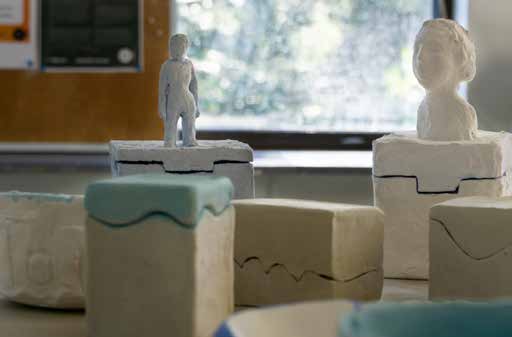
Ceramics however weren’t Kirsty’s first calling, but rather a way to cope with her hearing loss. Doing something new and creative became a “fantastic way to spend [my] time and to get through things”. She studied and worked as a web designer for over a decade before returning to university to complete a Masters degree in electronic and temporal art.
Her passion for art grew at the age of five when she made the decision to become an artist. Kirsty’s life hasn’t been without art, but when her hearing began to worsen she made the snap decision to start creating ceramics with the belief that “you can’t be sad and make beautiful things”.
Outside of the Auslan workshop, Kirsty has dedicated her time to experimenting and developing new ceramic artworks and tableware which incorporate braille and Auslan to engage both deaf and blind communities. Last year she created plates with braille, a project she describes as challenging her skills due to the need for consistency. This time around Kirsty says she is going freehand, which she has found to be a much faster process to “work everything out by hand first and see what works.”
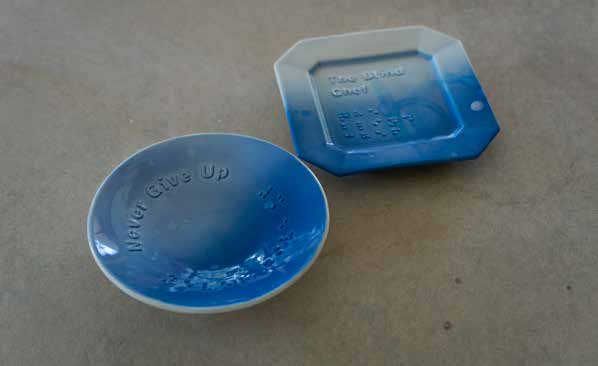
Kirsty is continuing to pioneer disability design through her ongoing efforts to create Auslan tailored ceramics. She has set herself the challenge of capturing the moving language of Auslan, where pieces would form words; a way for her to speak to her audience. “I need to see how it is received by the deaf community,” she says. “They might say to me ‘that one doesn’t work’ or ‘I don’t get that one’… so I need to get that feedback from everybody.”
After learning that a number of people who have attended a class have never had the chance to learn Auslan, Kirsty hopes more people will reach out and find comfort in meeting others who have experienced a similar journey. She aspires to break down the inhibition felt by many through continuing to build an inclusive community. “It’s not the end of the world if you go deaf, it’s okay, you’re still a valuable community member.”
The Auslan ceramics art club runs on the first and third Mondays of each month. To attend the workshop, you can book tickets on Humanitix by searching Auslan Ceramics Art Club.