Category: Issue 1

  • Planting the Seeds of a Cultural Garden

    Planting the Seeds of a Cultural Garden

    Aboriginal and Torres Strait Islander readers are cautioned that this article contains images and names of people who have since passed away.

    Aunty Kathryn Dodd Farrawell is a Kaanju Birri woman who has lived in Glebe since 1972. Her artworks have enlightened the walls, gardens, and public areas of an Eora place rich with Gadigal belonging. She is a community member and friend to locals of many different walks of life, but loves spending much of her time with the younger people of Glebe. In opening our discussion one Winter’s afternoon in the office of Glebe Youth Service (GYS), Aunty Kath reflects upon and acknowledges where it is that we are meeting. “I live on the lands of the Gadigal people,” she says, “and pay respect to their spirit and their belonging in the waterways and everything that was and always will be Gadigal Land”.

    Aunty Kath’s artwork is grounded in a sense of responsibility to her lineage, in truthtelling, but it also embodies a celebration of the beauty and belonging of the land and community she holds so close to her heart. “I love Glebe because it is a cultural garden,” she says, “of everyone coming together, foodwise, people-wise, and connections. So, when you come to the Youthy (GYS) and are living around Glebe, you’ve got people that express and walk with their art. Our old people, we express it through the arts. When you see the young people doing their beautiful art, it’s got that inner beauty. It speaks and it expresses, and we have people of all different ages doing it in different forms. We all team together and it all comes together around Glebe. You have the recording studio downstairs. It’s all good fun, and it’s their Voice. I can’t play an instrument, but I love listening to beautiful music. The simplicity of people making music. It’s good medicine. My dad and my brothers would be singing, and my dad would be playing guitar. We had that beat in our heart”.

    “When you see the young people doing their beautiful art, it’s got that inner beauty. It speaks and it expresses, and we have people of all different ages doing it in different forms. We all team together and it all comes together around Glebe.”

    Aunty Kath’s father, Reg Dodd, was a Birri man, born to his mother Emily on the riverbank of the Bowen River in 1907 (near Strathmore Station) – he is remembered as a fighter for equality, for human rights and justice, and for being a wonderful father. Her grandmother Ruby was a Kaanju woman from the country’s northern point (what’s now referred to as Cape York). Aunty Kath’s mother Kate was from near Cooktown, and her Aunty Ellen was born on Palm Island. Aunty Kath experienced the dawn of her life further south on Darumbal Country. It covers what’s now known as the Rockhampton and Capricorn Coast Area. She was the last born into a family among eight brothers and two sisters.

    The Darumbal People live through a belief in oneness, an interrelationship of country, people, with all that exists. This frames their way of life through a complex system of social and spiritual activity. They were first encountered by Europeans in 1853 when two pastoralists, Charles and William Archer came across the land in their travels. One year later the traditional owners were removed by British colonial forces. By 1860 those of the Darumbal people that survived the frontier wars were dispersed onto government- run missions over 200 kilometres away. At the beginning of the twentieth century there remained one hundred recorded Darumbal survivors.

    In remembering her childhood on Darumbal Country, Aunty Kath speaks of good, hard working people and fond memories. “We were allowed to be children down at the creek and playing in the mud,” she says, “playing in the sand, always encouraged to sing. It was good fun growing up with my cousins around the tamarind tree. We were encouraged to do art and be who we were and where we come from…even though they (her family) were separated from the culture with the Aboriginal Protection Acts back in the day. There was always fear of children being taken, your family being split up by the authorities. And that’s what they did”.

    The Protection Acts were first introduced by the Queensland government in 1897 and reinforced by subsequent amendments in the decades following. The new legislation gave public and private administrators unprecedented authority over the lives of Aboriginal and Torres Strait Islander people. Indigenous agency was legally eliminated, which ultimately led to the wide-spread razing of Aboriginal camps. The inhabitants were removed by men on horse-back using 9 stockwhips and firing bullet rounds above their heads as they were led away to wherever their labour was needed.

    (Figure 1.1) portrays her parents who, along with her grandmother, had felt the full consequences of these laws 65 kilometres north of Gurambillbara (Townsville) on Palm Island and removed to Woorabinda Aboriginal Reserve – west of Rockhampton.
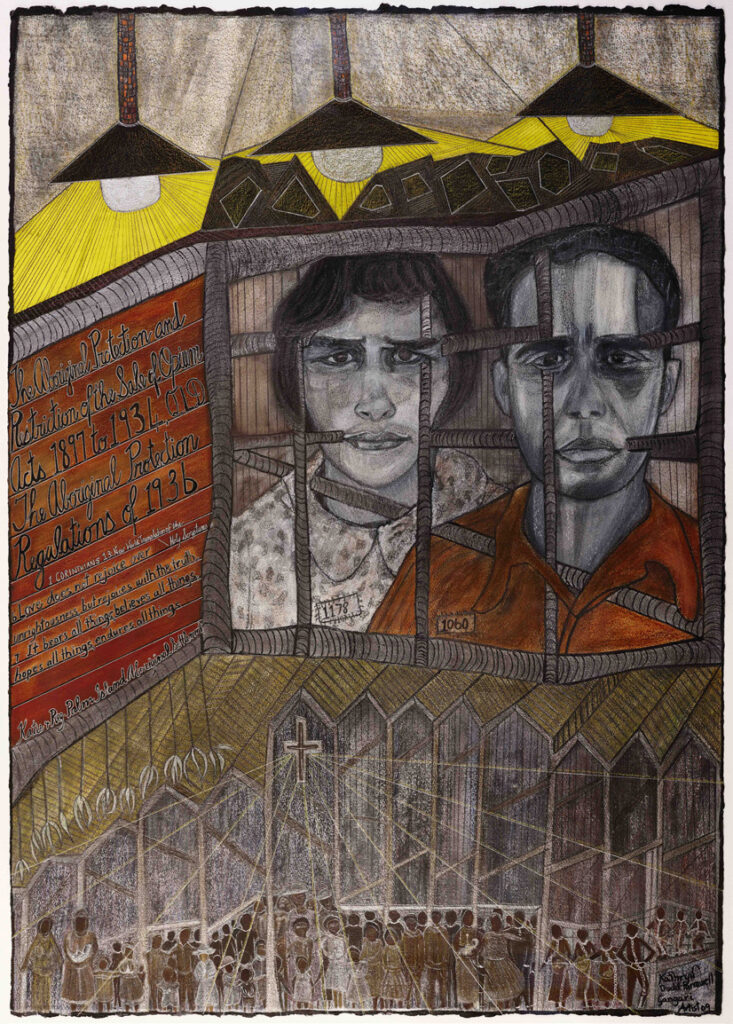
    Pencil drawing and Watercolour on Paper artwork by Kathryn Dodd Farrawell called Love Endures All Obstacles.
    (Figure 1.1)

    “That’s where mum and dad were locked up under the Protection Acts back in the day…and they were given a number and referenced as a ‘breed’. When I first started doing this, someone said, they don’t look right, those lights, you have to fix up those lights, and I had to fix them up, but this is the light shining on the truth, and they were in chains there. It was a penal reserve. People had no freedom and no rights”.

    Whilst often portrayed in the media as an exotic oasis, Palm Island was among the harshest places for Indigenous Australians to be sent by the Queensland authorities. Prisoners were kept to a strict regime of unpaid labour and gestural conditioning under their white subordinators. In the 1930s a local doctor vocally expressed his concern for the malnutrition on the island, demanding that the authorities at least triple the nutritional supplies of the prisoners. This recommendation was denied. Indigenous detainees were banned from speaking their own languages or conversing with white officers.

    The Protection Acts and the resulting Palm Island penal reserve embody critical yet not isolated junctures in the history of colonial injustice towards Indigenous Australians. The remaining wound is still felt by descendants, as can be seen in the artwork of Aunty Kath. Her work has embodied the struggles of her family, her friends, and First Nations people throughout her lifetime – from a local focus on her home in Glebe, to a countrywide commitment to truth-telling and Indigenous acknowledgement by the punitive settler political system. “You still see it through the intergenerational trauma of Mother Earth and her children today,” she says.

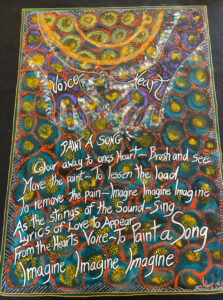
    “Sometimes it is your Voice coming out. Sometimes it’s a way of connecting people, and sometimes it’s a gift back to people, to recognise them.” When asked about her creative process, Aunty Kath says “You might not have anything one day, or the paintbrush might not be calling, but then all of a sudden, it happens … With the Voice referendum, I felt that doing some art and expressing through words – I don’t call it poetry – but it’s having an expression, not in big words but in your words and listening to your music. When we were in Brisbane, my niece and I went on the march, and there’s about 20,000 people there, and it’s a sea of grey hair, and Yes t-shirts, and we said, who would have thought?”. The artwork displayed in (Figure 1.2), and the message of hope held within it, was painted by Aunty Kath during the national referendum for an Indigenous Voice to parliament. “I pulled the old hair out of my hairbrush to paint this,” she says.
    Aunty Kath now dedicates much of her time towards passing on her knowledge and creativity with younger ones. Regularly doing workshops out of Glebe Youth Service, she sees the light of imagination in younger people, and in creating and making art for and with community. “It’s more like a family I think that comes within Glebe,” she says, “You see the young ones growing up and you see their talents and you know they get in there and do it. There’s some other beautiful people that encourage them to paint and having a space that’s provided for that to happen too is important”.

    zAunty Kath speaks in tones of respect and admiration for her fellow Elders and artists that have helped plant the good seeds of Glebe’s flourishing. “There was another beautiful artist that lived in Glebe,” she says, “and that was Aunty Elaine Russell,” she says. Aunty Elaine was a Gamillaroi painter and illustrator. She was born in 1941 on Nucoorilma Country, in Tingha of Northern New South Wales. Aunty Elaine’s artworks depict the memories of both light and sadness that are tied to her upringing on the Murrin Bridge Mission. Since the 1990s Aunty Elaine became an integral part of the Gadigal, and especially of Glebe’s creative community. “She is and always will be an amazing artist,” says Aunty Kath. “If you get a chance to look up her artwork, and her books, she’s an amazing world-famous artist. Aunty lived in Glebe, and you look at the colours she used…they were her stories of belonging”. Over three weeks in 2011, The River Song Mural (Figure 1.3) was created in the canteen area of Glebe Public School. It was designed by Aunty Elaine Russell who also painted it with the help of Liz Rooney, alongside many appreciative young students.

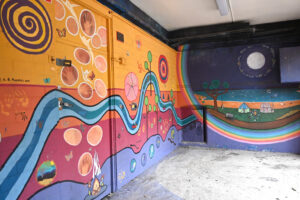
    Several years later, another art project was created along Elsie Walk, bordering Glebe Public School. It was coordinated by Liz Rooney and painted with the help of Aunty Kath and other community artists, young and old. “Our beautiful Lizzie was organising that over a long period of time with the rainbow,” she says, “It was for Elsie’s Women’s Refuge at the school. It was the forty-year celebration of it being open”. In paying a deep respect to her legacy of warmth, nurturing, and creativity, Kate Brennan and Liz’s sister Emma Rooney collaborated to paint an image of Liz, at work on the mural, into the mural itself. Liz’s loving family also helped to complete the mural (Figure 1.4). “Our Lizzie is kneeling and painting her beautiful rainbow of love, hope, promise and equality for all,” Aunty Kath says.
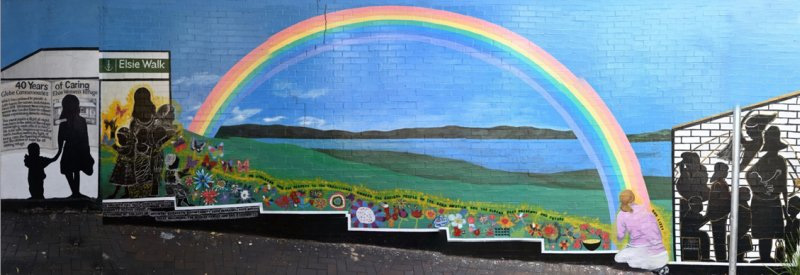
    (Figure 1.4) Elsie Walk Mural bordering Glebe Public School, designed by and featuring Liz Rooney (bottom right)
    (Figure 1.4) Elsie Walk Mural bordering Glebe Public School, designed by and featuring Liz Rooney (bottom right)

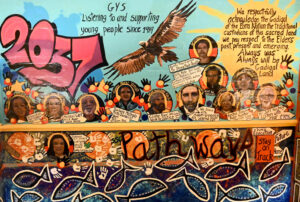
    Community artworks have been shown to tell stories that engage local communities in discussions grounded in truth-telling and a collective spirit. Often regarded as a form of ‘counter-storytelling’, artists share knowledge with their communities, portraying realities often not told in the broader public conversation. Artists such Aunty Elaine, Aunty Kath, and Liz Rooney, help to create tracks across cultural fractures and untruths. This also strengthens connections between generations: young and old come together in a mutual sharing of teaching and learning. This can be seen at its full potential on the walls of the studio space at Glebe Youth Service, where in 2020 Aunty Kath and young artist Georgia Frew coordinated a mural that was painted by locals young and old (a section of which is shown in [Figure 1.5]). It is dedicated to Glebe’s powerful lineage of leadership and inspiration, as well as a homage to First Nations legacies across the country – past, present, and emerging. Always was, always will be.

    “That’s why the Youthy is really important,” Aunty Kath says, “and things can come about. And you say to young ones, just be yourself, do your own. That’s what you’re about – how you put down and you make your shapes or how you want to do it. And you learn as you go along with the process in different ways. You grow up and it’s where you live and who you are, and who you relate to and who you belong to in your community, and in your belonging country”.

    “Everyone has a Voice, yeah, a way of projecting. They know themselves; they know they’re talented. Sometimes it is your Voice coming out. Sometimes it’s a way of connecting people, and sometimes it’s a gift back to people, to recognise them, and for people to understand, you’re all right, you can do it, yeah, we can do things together, there’s a remembering of the old people we belong to, and as I said, there’s a connection. A deadly red, black, and yellow connection to Mother Earth”.
  • “It Starts Within”

    “It Starts Within”

    It’s a Monday evening at Glebe Youth Service and Mali and Sarah are sitting alongside each other. They seem at ease, with a calmness of being at home. The building is filled with the laughter and screams of about a dozen primary school kids unleashing that uniquely powerful force of after-school energy. 

    About an hour ago, we all sat around the stereo monitors in the half-office, half-music studio, listening to a new song created during the after-school program. They all chanted the choruses together whilst individually adding their own lyrics to the verses over a well-polished hip-hop beat. There was a refreshing honesty within each phrase that only children could bring. It really sounded like a hit. 

    Seventeen-year-old Mali was involved in guiding the production process. “I’ve always been into music’ she says, ‘I knew I wanted to do music, but I didn’t know where…I started coming here every week and then I did a little course with people teaching me how to use the room … and then I just started using it”. She’s now employed tutoring music production for Nakama Arts – an organisation focusing on collaboration and enhancing creativity throughout the country. In partnership with Glebe Youth Service, they started ‘Studio 37 Open Studio Sessions’, a two-hour workshop session every Wednesday afternoon from 3:30pm at GYS. Mali went through the program herself in recent years before being officially brought onto the team. Her influences run impressively deep into the hip-hop lineage and beyond. “In terms of rap: J. Cole, Drake, Brent Faiyaz … I like a lot of old school as well like Jay Z, Biggie, definitely Biggie, Lil Wayne, Aaliyah, Sade”. 

    Both girls grew up in Leichhardt and attended high-school together. They started coming by the service during their early teenage years after hearing about it from friends. Sarah has just walked up the stairs from helping manage the joyful chaos below. She is studying her Certificate IV in youth work at TAFE and is completing her placement hours at Glebe Youth Service – the place she knows best. When asked why she wanted to do youth work she says, “it became a massive passion when I grew up around here. Family stuff, just experiencing how kids feel and act. Obviously, life isn’t easy for everyone, and it’s really cool to know how to support children, the best way that you can. I went to TAFE and thought I’d try it out and see what I can do. And I loved it. I loved the theory work. The only theory that I’ll do.” she says laughing. 

    There’s a passion in Sarah’s voice which suggests that this line of work is choosing her as much as the reverse. You can hear a fierce sense of social responsibility that seems representative of her generation. But she also appears grounded in a realistic, grass-roots outlook, usually observed in the lived experience of well-versed social practitioners. “I think kids need heaps of support,” Sarah explains, “they need the most support they can get. Whether it’s joining a sport team, doing music like Mali, stuff like that can completely change the way that kids think and feel and act. Just being there, listening. They need to people to hear them.”

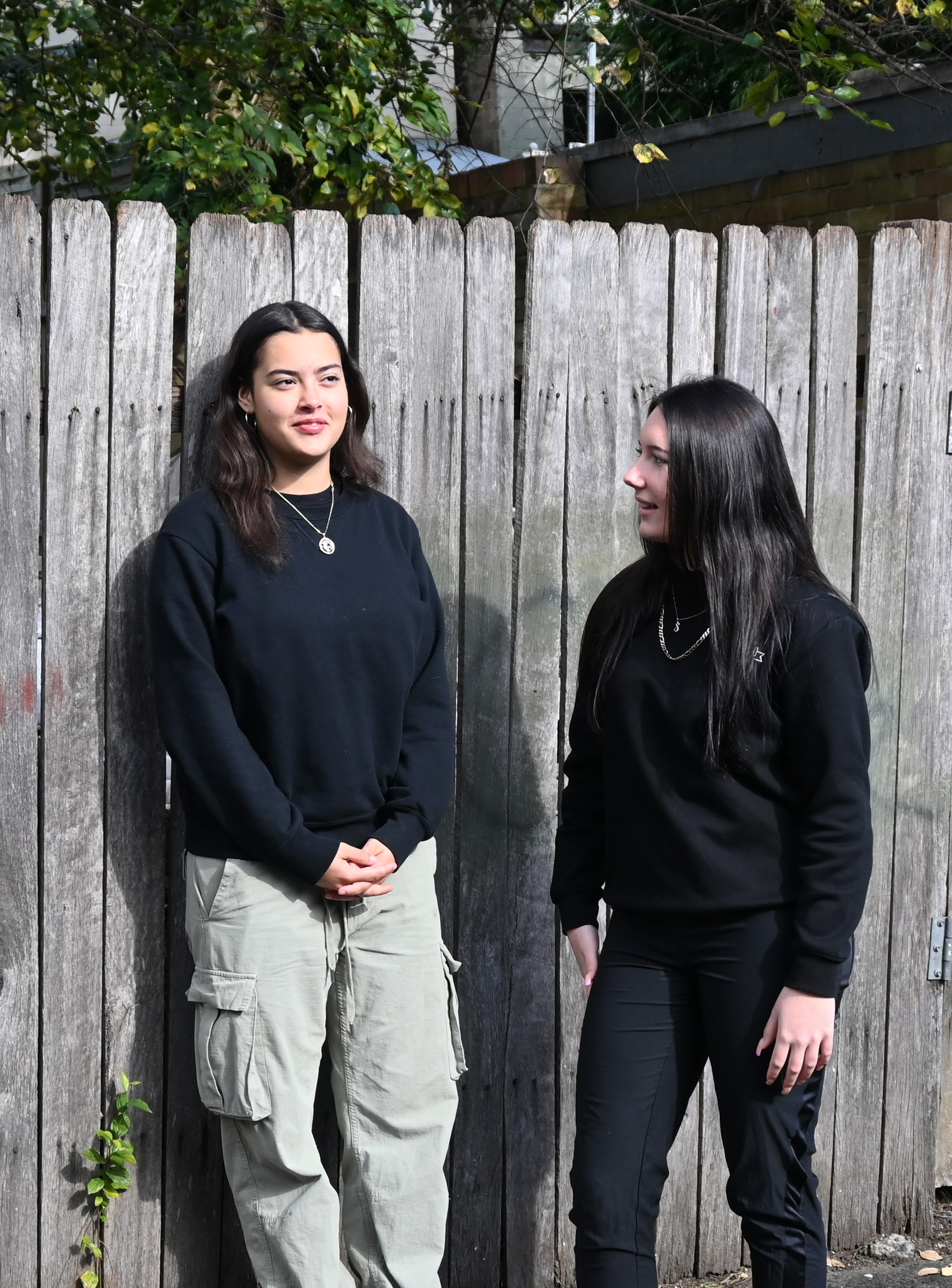
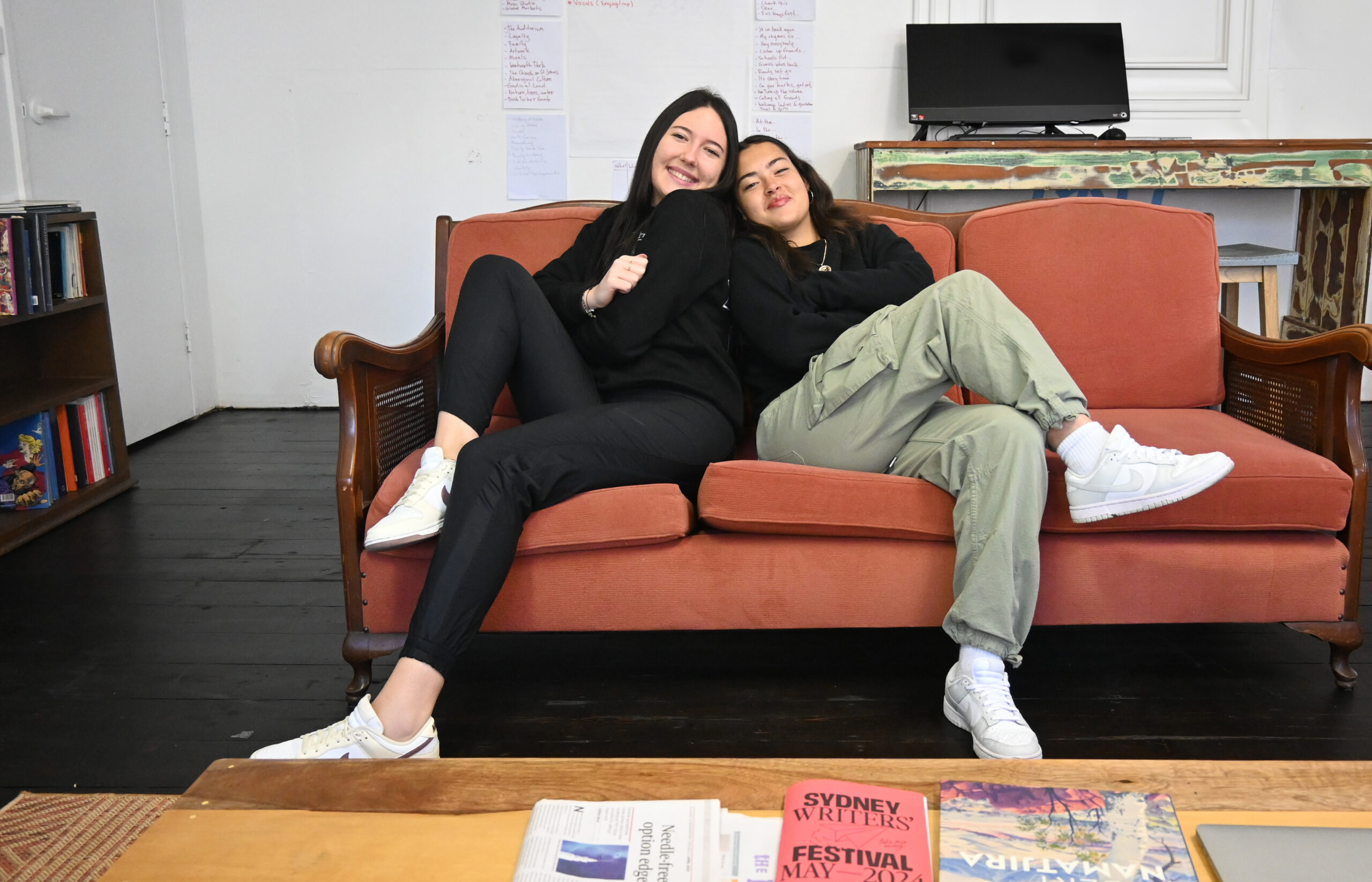
    Sarah (left), Mali (right), sitting upstairs at Glebe Youth Service
    Sarah (left), Mali (right), sitting upstairs at Glebe Youth Service

    Her knowledge and perspective have been shaped by her years in this very building. She learned from her mentors, who strive to connect with anyone wandering through the entrance, up to the basketball court, or further back to the kitchen for a free meal often cooked by Habil, a respected youth worker, chef, friend, and long-time guide to many. “You hang out, you chill, you’re with your friends,” Sarah says, “People who you are comfortable with. You learn about stuff that you wouldn’t really talk about at school. We talk about culture. 70% of the people that come here are Aboriginal. So, you learn more about them. You learn about the Elders, the aunties, the uncles. Habil has been around for ages, he’s cool, you know? And the boys and girls, they come together so well here. But outside, you just do your own thing. You can just do whatever makes you comfortable and happy here and when it’s time to go home everyone’s like nooo I don’t want to go yet”.

    To this, Mali agrees. There’s a sentiment of security – of connection to a larger family. You get the feeling that it’s one they are proud of. “It just felt like a great space to come after school,” she says. “It felt calm and safe, and you could have a feed. And as you get older… I’d rather come here on the weekend than do other things. I’d rather come down here and see everyone… As an only child, I’ve never had many people my age around me, and this was a community I was comfortable in,” Mali says.

    They both speak earnestly about their time here. The felt connection to community runs deep and has provided them with important skills and passions that now light-up the path ahead. They seem excited about the future, without feeling the impending pressures of time so common to those reaching the end of high school. “I want to work for a bit,” Sarah says, “go into the industry and think and see if this is something I really want to do. I have the rest of my life. If that’s something I really want, I’ll go straight to uni. But I definitely think this is something I really want to do.” 

    Regarding her future in music, Mali adds, “I want to make a fulfilling career out of it. I want to make music that I genuinely enjoy. And work with people and just… make music”.

    “Something that I’ve learnt through music, and through coming here is that, as funny it sounds, it starts within. And especially if your home life isn’t feeding that to you from a young age, in the developing years, if you can’t source within, you’re not going to be able to source externally”

    The combined insights of both young women show the importance of youth services. It displays how places like this provide communities with the foundations to come together in times like ours, when connection seems more difficult to nurture against the isolating effects of modern technology and a global pandemic. Mali emphasises the importance of young people finding themselves within a community and, through drawing upon her own experience, describes how creativity can offer such a path forward: “something that I’ve learnt through music, and through coming here is that, as funny it sounds, it starts within. And especially if your home life isn’t feeding that to you from a young age, in the developing years, if you can’t source within, you’re not going to be able to source externally, that’s why kids are so easily turned to drugs and stealing or whatever it is, because it gives them a satisfaction externally that they’re not getting within. And with music, I think it’s great to have that kind of expression and you can start to feed whatever’s within, to something external, and you can build a better relationship with yourself. And then you can start to look at beneficial things and positive places to go and you can give yourself the ‘I deserve it’, or ‘I want it’

    The experiences of Mali and Sarah, both now soaring towards adulthood, teach us how we might build a stronger sense of connection for young people: it comes from those closest to the ground, from community – from within.

  • MeJane

    MeJane

    Ann Curthoys is a Sydney historian whose extensive body of work reflects the troubled past of colonial Australia. Perhaps most notably, in 2002 she published the book Freedom Ride: A freedom rider remembers, which retells her experience as a university student engulfed within the political activism of the civil rights movement during the 1960s. It is a first-hand account of how over 30 University of Sydney students – among them renowned Arrenrnte and Kalkadoon activist Charles Perkins – travelled across the country by bus to fight against racism and bring Indigenous rights to the forefront of public discussion.

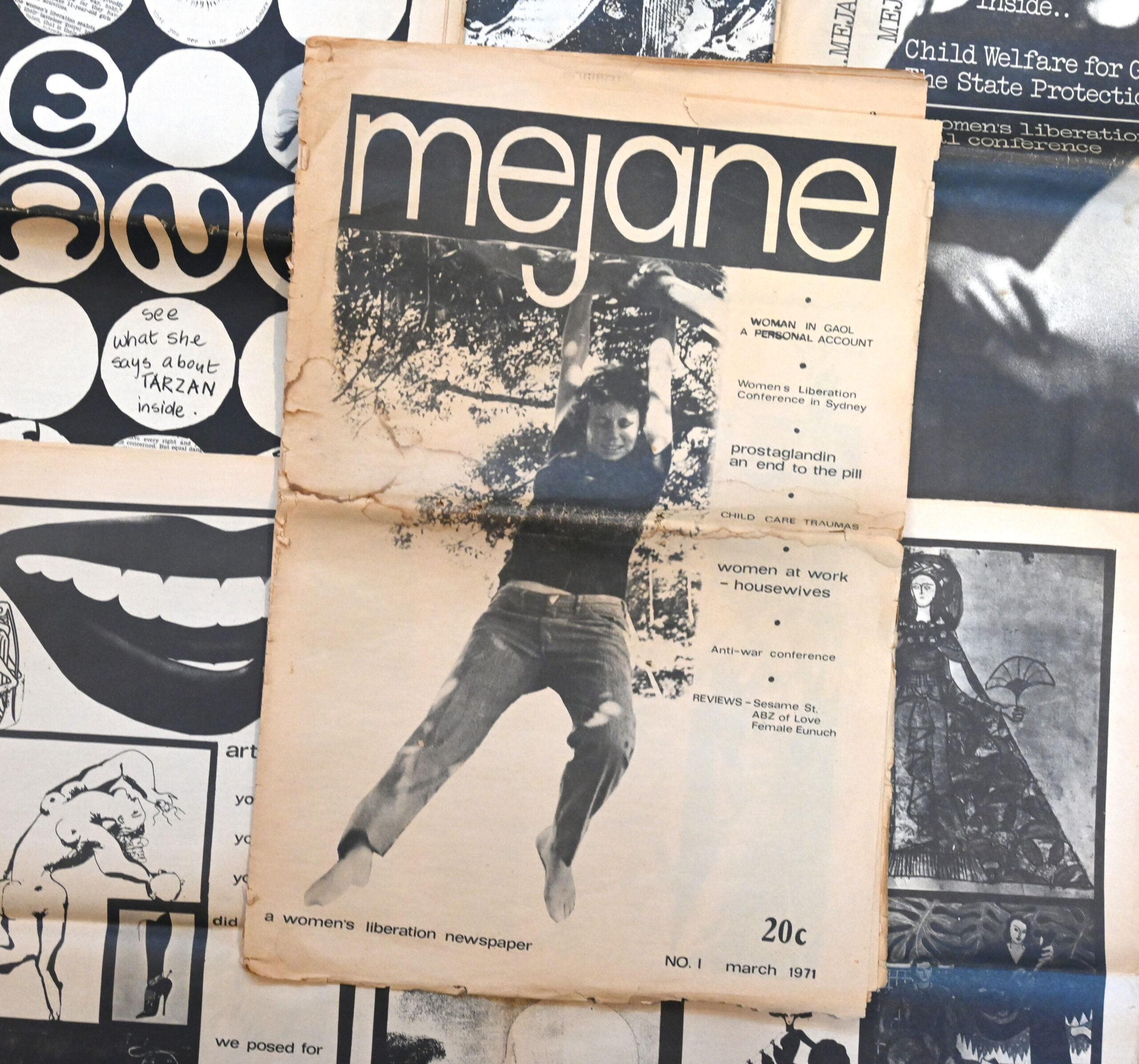
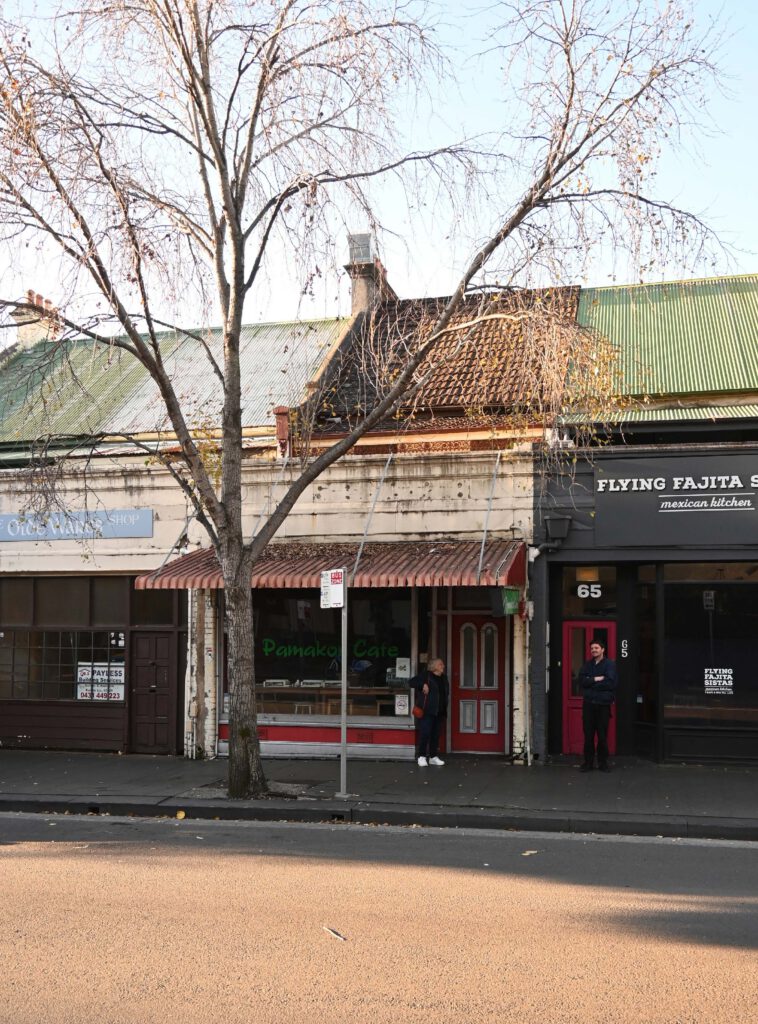
    In the decade following, Ann became involved in another project, looking to the inequality faced by women across the nation. It was the first women’s liberation newspaper to ever be put to print within the country. “It was a product of Sydney Women’s Liberation, which started at 67 Glebe Point Rd,” Ann says, “there was a group that met before that in 1969, but by 1970, I was meeting there”. This period is now marked as the peak of feminism’s ‘second wave’, arriving with the emergence of a university educated generation of young women, bound together by the common plight against a male dominated system which they felt more than ready to confront. “Ours was the generation where women were getting good access to education,” Ann says, “but not a lot of the jobs that follow from that. So very restricted occupational pathways. You could be a teacher or librarian. So I think there’s that aspect of it … educated women wanting to demand more”. Australian feminism had until then scarce literature of its own, and ideas were drawn upon from the emerging feminist scholars across the pond. “We were reading lots of American stuff,” she says, “kind of reproducing it and writing little leaflets on our own. We said we’ve gotta really write our stuff. And so MeJane was really part of that, of producing our own work in Australia for Australian readers. And so, we did. And I don’t think any of us had any experience of doing a newspaper or any training.” The first edition of MeJane was released in March of 1971. The cover photo features Ann, aged 26, swinging from a tree in nearby Annandale where she and her partner (now husband) John Docker resided. Ann explains the significance of the first cover photograph (shown above as the feature image of this article). “We decided we wanted to represent the idea of Jane,” she says, “not Tarzan, but that Jane was at the centre of the story. I can’t remember how it got to be me. But it was shot in the park opposite where we lived in Annandale, now called Hinsby Park, and it all developed from there”.

    “We decided we wanted to represent the idea of Jane, not Tarzan, but that Jane was at the centre of the story. I can’t remember how it got to be me. But it was shot in the park opposite where we lived in Annandale, now called Hinsby Park, and it all developed from there”.

    All twelve editions were produced at 67 Glebe Point Rd, known then as The Women’s Liberation House, in which several student activists lived. The set-up was authentically DIY with essential tools like a Gestetner copying and printing machine, Letrasett (for typefaces), graph paper, a Varityper machine, and plenty of caffeine. MeJane projected a vocal resistance to the systemic subordination of women in the country. In 1970, there was a luxury tax on the contraceptive pill, and the advertising of family services was limited. To be permitted access abortion services, women had to prove that they were mentally unstable. This was on top of a routine silence around domestic violence, with no existing services for women or children to access. When asked of the underlying issues of focus, Ann speaks of, “sexist attitudes and behaviour: sexism. Although we didn’t have that word at the beginning. It was male chauvinism. Recognising all issues to do with representations in the media, lack of cultural respect, those kinds of more cultural issues. So, I think for a lot of people, those things came together, a kind of restlessness about their place in the world and an objection to sexist discourse”.

    The house also acted as a venue for regular meetings of Sydney Women’s Liberation, a melting pot of ideas, friendships, critical thinking, and consequently – action. “You’d go to one meeting somehow or another,” Ann says, “you get involved and people are talking about their experiences, and you realise you’re part of a bigger group. And so, it becomes a movement of people wanting to demand more”. Of the meetings there Ann says that they “really were like nothing else. In the early stages it really was people sharing ideas or experiences. I think as time went on, it became more activism and planning. There was quite a campaign around the question of abortion in 1970. And there was the 1971 law decision which made abortion much more accessible. In those early stages, abortion was a big campaign issue”.

    In a court case held in 1971, Judge Levine of Sydney Central Court ruled five Bondi health clinicians to be not guilty. They were faced with charges of conducting illegal abortions. The decision came after years of campaigning, as well as protests outside the court proceedings by Sydney Women’s Liberation as part of a broader pro-abortion coalition. Judge Levine’s ruling set a new precedent for abortion laws in Australia, opening the doors of specialised clinics and a more flexible public discourse around the issue. It seems that there was a sense of real change in the air, carrying off the inky pages of publications like MeJane, out to the picket lines of feminist rallies and protests outside the courthouses, finally wafting its way through the wooden court room doors and onto the transcript of Australian history.

    “You’d go to one meeting somehow or another, you get involved and people are talking about their experiences, and you realise you’re part of a bigger group. ”

    “One other feature of that early time was that the media, including television, got onto it quite early.” Ann Says, “They found it interesting, and I can remember some journalists coming and wanting to talk to people there, and they were often pretty clueless about the issues. You know, “what are you women on about?”. Very naive journalism. But we didn’t have to struggle to get attention actually”. It is likely true that the glaring oppression of women in the country could no longer remain ignored. Yet, the attention and resulting change during this consequential period can be viewed as a testament to the proactive, collectivist mindset, and the vision of a cohort of women eager to shift the course of history.

    On the changes within feminist discourse since MeJane, Ann says, “it has been through all these phases really, including a lot of backlash and anti-feminism. I think in the 90s it got very hard for women to say they were feminists. I think it’s come back as a legitimate important thing. But in terms of the issues that feminists face: there’s still cultural representation. That is still there. But one thing I’ve got more involved in recently with two other women is writing a history of domestic violence in Australia. And I’ve realised that although women have made a lot of advances in a lot of areas, the violence continues, and I’ve become aware that it’s not just Australia that that’s happened. I’ve gotten very interested in why. That has now been seen as a big issue for 50 years. I think quite a lot of policy developments have been quite good, but there’s still something really fundamental going on”. Fifty years since the final edition of MeJane was published, Ann is still challenged in understanding the persistent problem of male violence. Though without the ambition of collectives like Sydney Women’s Liberation and MeJane, we’re left to drearily wonder what our current society might otherwise look like. Such movements show the power of collective action and the written word in the face of rigid oppressive systems. They provide branches of hope and inspiration to cling onto in the darker hours when things might seem all but hopeless.

    In 2012, Suzanne Bellamy wrote an article reflecting on MeJane as some of the foundational years of her life. Sue passed away in 2022 at the age of seventythree. “She was a really key person,” Ann says. “She would always organise us to do the layout. And she would tell us there’s a deadline … There was no deadline, she made it up,” Ann says laughing. Sue wrote in her reflections that “we learned to swear at Glebe in a whole new way, and it was almost always hilarious”. Upon hearing this Ann laughs again, “Well, people didn’t swear then. And women particularly didn’t swear much. Men would swear with each other. But they didn’t swear in front of women. She’s right. That’s where you got to practise swearing. It’s a world that you kind of knew was there, but it wasn’t your world. She was very funny Sue, a very charismatic person. The one that kept it together”.


    This article is dedicated to Suzanne Bellamy, Camille Guy, Gale Kelly, Sue Wills, Martha Kay, Joyce Stevens, Julie Gibson, Bessie Guthrie, Lesley Lynch, Sandra Hawker, Martha Ansara, Coonie Sandford, Lyndall Ryan, Mary Murnane, and Sydney Women’s Liberation for giving a voice to voiceless women across the country.

    The echoes of which still resonate fifty years on.