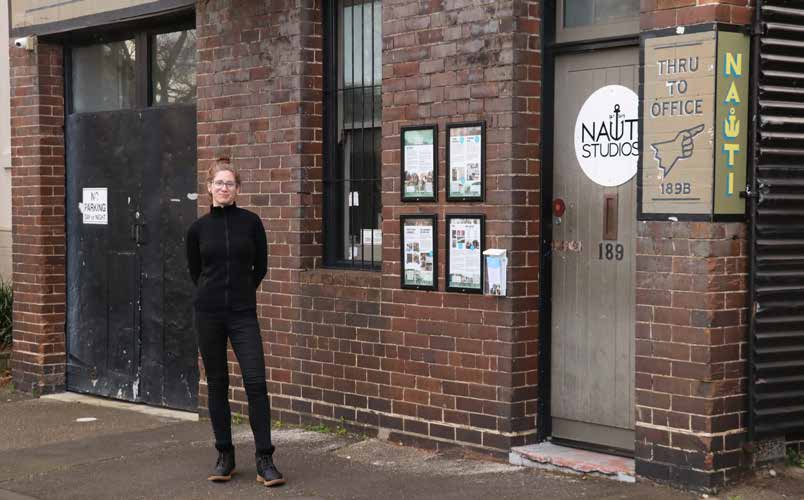
For over twelve years, Nat Cheney has been on a mission. A mission to provide an affordable community workspace where creatives can dedicate themselves to their art whilst also fostering collaboration.
Before this, in her early twenties, she scoured Sydney for an established creative space, but nowhere sparked a connection. There was no sense of belonging. An illustrator from the Northern Beaches, Nat felt the waves of procrastination that often blighted creatives’ practice and, particularly, the constant blurring of boundaries between work and home.
“I tried illustrating at home for a little while but I never felt truly rested or never truly productive,” says Nat. “Say I’d be working and the couch was right over there and I’d be like ‘I could watch one more episode of Battlestar Galactica’. Then I’d be on the couch watching it and thinking ‘I really should be working’ and I would feel really torn about one or the other.”
Nat needed a place; a studio that could compartmentalise her life.
Through regularly attending an improv class, she discovered that other creative people shared her frustration about the lack of a communal space. Spontaneously in 2014, she founded Nauti Studios. The name was derived from the word nautical, and emerged from her “obsession with the ocean.” Nauti Studios was born in Stanmore during 2014, a nonprofit company that represented her ideal vision of a communal artistic space replete with nautical imagery throughout.
After recovering from the lockdowns, Nauti Studios was forced to relocate in 2023 after almost a decade at their first location in Stanmore. Now located on the border of Glebe and Forest Lodge on St Johns Road, Nauti Studios has been a safe haven and productive outlet for a diverse range of people. This includes: painters, illustrators, roboticists, florists, glass blowers, hairdressers, professional clowns and even someone who 3D prints gravestones.
The space is made up of three combined warehouses which cater for over fifty artists. They were originally occupied in the 1940s and 50s by John Durst, the first person to bring electric motors to Australia.
Nat emphasises the benefits of working in a multidisciplinary environment; how through conversations and making connections across various art practices, one can step out of their own frameworks of inspiration and into new, foreign worlds.
“If you have lunch with someone like Ed who does robotics, I don’t know what he’s going to talk about. Then he talks about something and I’m like ‘I didn’t even know that existed’. It takes me out of my own world as opposed to talking to another illustrator,” explains Nat.
“When I was in a studio in Melbourne, I was illustrating and there was a space with a sculptor. We’d sit down and our mediums weren’t the same but when they would talk about their ideas it would ignite something in me. It doesn’t matter that it’s a different medium. It’s almost like because what they were doing was different, it was more stimulating.”
“It’s always been really diverse. I never set out for it to be that way but that’s how it worked out.”
Over the last 18 months, Nat has been working by hand in the construction of each studio space. Her hard labour mixed with an unwavering ethos of sustainability provides individuality that goes against the ubiquity of cookie-cutter, corporate office cubicles, breathing a new life into the environment.
The character of the space comes from the pastiche of oddly combined elements that nonetheless work well together. The chocolate-coloured wooden doors carved with symmetrical patterned squares, rusted winches hung from the ceiling reminiscent of Durst’s motor workshop, recycled lounges in the entrance, exposed ceilings emphasising the industrial past of the space, all contribute to this uniquely designed collaborative environment.
Nauti Studios holds several types of social gatherings in the industrial warehouse (known as ‘The Deep’), and the plant-filled foyer (known as ‘The Dock’) that was once used as the motor workshop. Each week on a Tuesday is ‘Jazz Night’, monthly is the free ‘Sydney’s Best Worst Movie Night Club’. ‘Sydney’s Plant Doctors’ is a monthly workshop where people learn how to nurture indoor plants from ‘The Plant Doctor’.
“My initiative is community and cultural events. If someone says ‘I’m doing this thing for the community or I’m doing this creative thing’ then I think ‘hell yeah’. As long as it’s under that bracket then it’s welcome,” says Nat.
At the studio entrance there is a parked boat, impulsively bought by Nat in the early days of the business. Now used as a makeshift plant display, it reinforces the sustainability initiative that fills the space.
“I had a few people tell me that it saved their lives and their mental health. People were telling me about how their practice developed by being here. I like hearing stuff like that. Anytime I have a doubt about what I’m doing I’m like ‘No I’m ok’.”
With 12 years of experience at the helm she is no stranger to dealing with the adversities that come with running a business. These get-togethers coupled with the tightknit community of artists has been “a real motivator” for Nat and kept her engaged.
“Because a lot of studios and coworking were open over COVID, because everyone has their own private, locked space, we had a strategy for people not to come in contact in the hallways, no one was allowed to use the computer space but people could come in to work. I had a few people tell me that it saved their lives and their mental health. People were telling me about how their practice developed by being here. I like hearing stuff like that. Anytime I have a doubt about what I’m doing I’m like ‘No I’m ok’,” she says.
Nat looks back over the years and laughs at her so-called “stupidity”. In the beginning of Nauti Studios, she regularly declined help, opting to build her dream alone. Nat now considers her crew as a “big help” to her success and an important reason that she continues working in this studio space.
“In the beginning, when I just started, it was friends,” says Nat. “The more people who joined the space like artists, would help out when they saw I needed it. Now as I’m more involved I know more people in business. Some people give me business advice or ideas.”
“As the people I know have expanded, the help that I’ve received is more varied.”
The goal has not changed for Nat, despite over a decade and more than 400 artists later with steady growth in the Glebe location and a second location in the Blue Mountains that houses 16 artists. Spending alternate weeks in each location, her aspirations haven’t changed.
“I’m probably just more aware of admin and management but my goals haven’t changed. My desire to provide affordable spaces for people to make stuff is the same, if not more so,” says Nat.
“My priority at the moment is to make sure this one [Glebe] is good, then we’ll see what happens. There’s no part in my mind that thinks ‘I want to have an empire’. I don’t think that’s where I come from.”
The only blueprint for a successful space, as far as Nat’s concerned, is through a persistent dedication to the local community and nurturing established and emerging artists.