Aboriginal and Torres Strait Islander readers are cautioned that this article contains images and names of people who have since passed away.
I
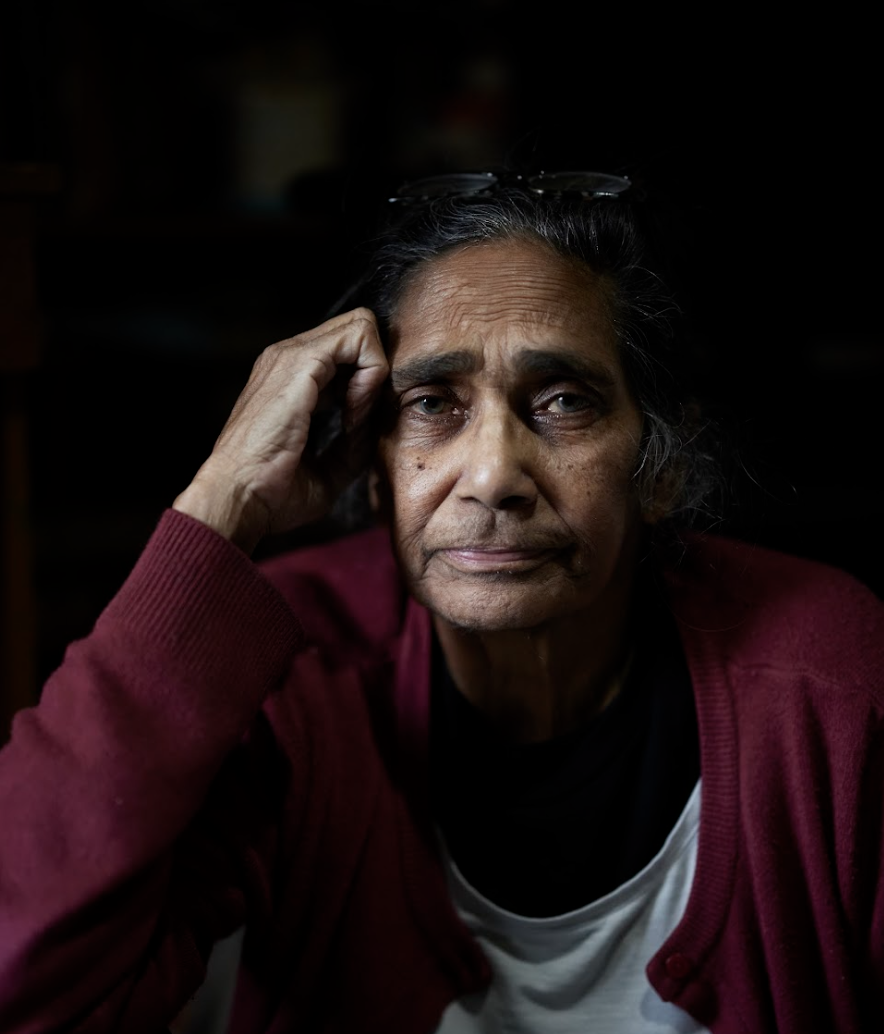
“I am a Gomeroi/Gamilaraay Murri Yina from the northwest of New South Wales and Southern Queensland,” Aunty Barb says one rainy morning in late January. In the Gamilaraay language, “Yina means woman”. She has just made her way down the wet footpaths of Glebe, a suburb she’s called home for over at over four decades.
Born on Gomeroi Country in 1950, Aunty Barbara McGrady has since become renowned as this country’s most influential female Indigenous photojournalist. Her work has projected and celebrated the strength and flourishing of Aboriginal and Torres Strait Islander Peoples throughout her life, with an intense focus on influential sporting figures, and the plight of her Peoples against the ongoing systems of colonial injustice. Whilst she has long called this suburb home, she says, “my family life, where I grew up, and my language group, that’s me. Before any of this, before Glebe, before anything.”
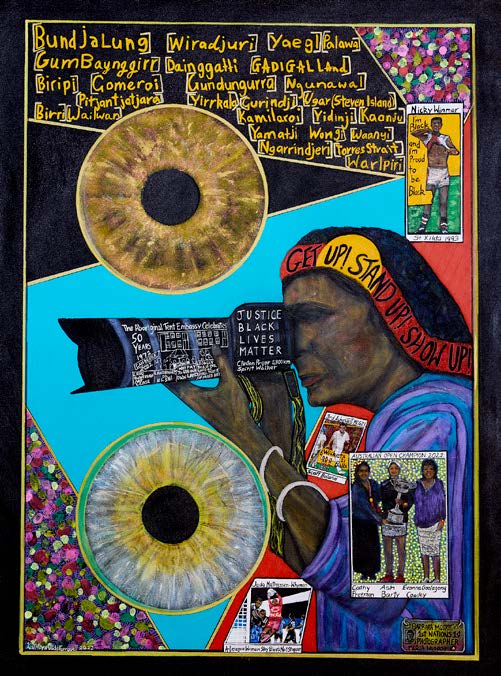
Aunty Barb describes Gomeroi Country as “a big, big area—second only to the mighty Wiradjuri group (in the central and western slopes of New South Wales)”. The Land stretches across a vast landscape of about 50,000 kilometres—up from The Hunter Valley in NSW to a northern peak of Nindigully in Queensland, with its western fringe spread across the Warrumbungle Mountains. The Gomeroi woodlands were long populated with Eucalyptus, Forest Oaks, Pines and a variety of Acacia trees. Its pristine waters ran through three major river systems— the Namoi, Gwydir and Barwon—before resting within their many catchments, all of which held an intrinsic source of spiritual and nutritional life for the near fifteen thousand Gomeroi People.
Their food supply was largely attained through sophisticated agricultural methods, long developed over 60,000 years. Nutritional life was sustained by a dependence on the vast amounts of Goolah Grass; its seeds grounded into flour and baked upon coals into round cakes of bread. Food was also acquired through masterful hunting techniques, and intricate fishing practices which included the construction of stone-walled catchments, capturing the many fish directed by increased river-currents after rainfall. The stone contraptions left the fish exposed in the shallow creek beds for convenient spearing or even to be caught by hand.
Gomeroi Country was heavily impacted by long and harsh droughts that continue to trouble European agricultural methods. Yet the arid lands could be transformed overnight by even moderate rains. The dry grasses would quickly return to life. The many herb species resurrected in thick green lots. Luscious waterways flowed again for the vast animal life that would soon drink to good health and breed plentifully. When the rains were overwhelming, the Gomeroi People would relocate to higher grounds. The nomadic lifestyle of the Gameroi Clan responded to a deeply ingrained knowledge of the earth, of its soils from which life would always grow, and of the weather systems dictating all. Contrary to the beliefs of European settlers (that often persist today), population movements were rigorously calculated. As anthropologist Roger Millis writes, “particular places were inhabited at favourable times of the year, often with a permanency that belied the conventional European image of the Aborigines (sic) as primitive nomads on perpetual walkabout.” The Gomeroi People were at one with Mother Earth in a spiritual dance that allowed both to thrive for many thousands of years.
The land’s nutritional value was perceived by European settlers, such as Alexander Paterson who wrote of the “luxuriant pasture”. They saw capital within the healthy soils, the undiluted waters, and flourishing woodlands. This opportunistic lens resulted in devastating consequences, upon the harsh, murderous methods of British colonisers in the Nineteenth Century—and in the years since.
One particular episode remains a horrific red stain upon this nation’s criminal record. It was in the shallows of a remote stream named Waterloo Creek that one of the most violent atrocities suffered by the Gomeroi people took place. On the 26th of January, 1838—the fiftieth anniversary of Captain James Cook’s arrival—Major James Winniett Nunn directed a group of mounted police and convict stockmen to the banks of a remote billabong. On the opposite side of the creek, a large Gomeroi group (estimates suggest as many as 1000) prepared themselves for the worst. The men dispersed their weapons and spread into defensive positions, allowing the women and children to flee. Initial clashes resulted in some of the horsemen being wounded by Gomeroi spears. In response, Major Nunn declared open fire. By nightfall, Nunn’s men would massacre up to three hundred victims—upon the very creek beds that had long nourished their existence. The events were mythologised in the years after, within a legacy of violent massacres across the country, yet have since become mostly deleted from the national memory. Such historical erasures have deeply altered the moral nature of this country ever since.
II
Aunty Barb was born over one century later in Mungindi, “a little town smack bang on the Queensland border … It’s been said it’s the only town in the Southern Hemisphere that’s on two sides of a state border,’ she says. “The majority is on the New South Wales side. There were two police stations, on either side… but I didn’t see any divide…. It was just on paper. A town grew on my land. On my Country.”
“I always had my say. Always knew what I wanted to say. Always stood up for the underdog, whether you were black or white. That was my mindset. Because I thought, who are you? It’s my land, my country. You built your little town here, but on my land. So, I always made that known. My mother would say: you can’t say all that stuff. Those white people will come and take you away. You can’t say things like that in public. You can’t say, ‘this is my land’ … I said that as a kid. I was a bit of a weirdo like that …”
Aunty Barb grew up within a large and supportive family, which included her six brothers and one sister. “I had great parents who looked after us, who looked after their own children, plus their nieces, nephews. My cousins came to my part of the country to work. It was a good home, you know, where everyone was looked after. Sometimes white people think we come from these disruptive, violent, horrible families with no love or no care or that there was just drinking, violence. I didn’t come from a family like that …They worked on the land. Everyone did. That was the only work going. We had nothing, you know…compared to white Australia. When we weren’t out on a property where my father worked, we lived in tin houses that my father and uncles built. And those little tin houses had to be a long way out of town. I grew up running everywhere. Because we lived three-quarters of a mile out of town. So, my brothers and father had to go to the local football grounds and tennis courts, and there was a tap there where you could get fresh water. They had to carry it in a yoke, with two pails hanging down on either side— full of fresh water.”
This was in the 1950s—before Indigenous Australians were legally recognised as citizens, and racism was far from veiled behind some of the social subtleties it wears today.
“You had to be out of town after six o’clock,” she says, “You couldn’t sit in any seat in a local picture show. You had to sit down the front in the hard seats. You couldn’t, of course, speak your language.”
Yet this did nothing to prevent her parents from passing the Gamilaraay dialect down to their children, nephews and nieces. The language proved to be a precious pathway into the past, igniting ancient connections to the Land, and strengthening powerful ties to the culture of their ancestors.
A viscous sense of self and Gomeroi identity was obvious in how Aunty Barb navigated the minefield of white oppression throughout those early years. She had a strong, and noticably loud streak of rebellion—a fire in her heart that raged upon the burning coals of racial injustice.
“I was very mouthy,” she says, “I always had my say. Always knew what I wanted to say. Always stood up for the underdog, whether you were black or white. That was my mindset. Because I thought, who are you? It’s my land, my country. You built your little town here, but on my land. So, I always made that known. My mother would say: you can’t say all that stuff. Those white people will come and take you away. You can’t say things like that in public. You can’t say, this is my land … I said that as a kid. I was a bit of a weirdo like that … My mother was sick on and off and in hospital quite a lot when I was growing up. My father was out working, and my aunties had to come and look after us. So, I had to—not fend for myself—but grow up quick, look after myself.”
Her mother’s concerns were undoubtedly rooted in her own lived experience, after a lifetime of internalising the violence enacted upon her family, her People, and the Land they had long held sacred. But deep down she knew that the strength and intelligence of young Barbara would carry her through the dangers: “My mother always said, ‘I’m not worried about you. You’re all right.’ Because I was that kind of kid, that kind of person with that mindset. I knew who I was, where I came from, so anything else didn’t matter.”
III
During these formative years Aunty Barb began to see people within the pages of magazines and newspaper who appeared more like her own: larger-than-life figures erupting into the public sphere before the civil-rights movement would inevitably explode across the Western World in the following decade.
“The big landowner, well known in the district, would give my father magazines, Life Magazine, Time magazine, Paris Review. So, I taught myself to read when I was about four or five. And I’d look through these great magazines and see these incredible photographs of black people doing incredible things. And I thought, wow. So, I was interested in Black people, Indigenous people from all over the world. Not just my own.”
At the age of 15, Aunty Barb’s mother handed her the tool which would frame how she expressed herself throughout most of her life.
“We had a Vox Brownie,” she says “I don’t know how or where we got it from. It’s like a little box and it’s got a real big lens”. This camera, she says, “opened up the world, opened up everything … There’s an old saying: a photograph tells a thousand words. I realised that people can read what they want to in photographs.”
Upon this epiphany of a greater world— through holding her many new heroes, printed black and white in the palm of her hands— Aunty Barb became determined to venture out and beyond the little town that was raised upon the land from which she grew.
“I knew for a fact I didn’t want to stay in my little hometown,” she says.
There was also of course a desire to remove herself from the discriminatory attitudes and conditions that became particularly infamous in the country’s north.
“It was oppressive, racist, insular, closed.”
After graduating high school, she became a nurse and moved south to Gadigal Land, finding work across the broader Eora Nation. She practiced nursing in both Paddington and Royal Prince Alfred Hospitals. Yet, she says, “I always knew that I’d be a photographer. I knew I would always tell our story, mainly through photographs. And whether I’d do it in a good way, a great way, or whether I connected with our people or mainstream society is another thing.”
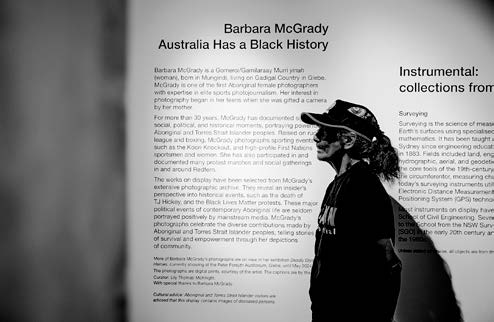
Aunty Barb’s career is certainly best portrayed through her work, a selection of which is displayed across these pages. In becoming a true master of her craft over the years, she has wholeheartedly acted upon that seemingly destined ambition to celebrate the beauty and strength of her people. Along the way she completed a degree in sociology at the University of Sydney. Her work has been featured prominently throughout this country’s media and arts institutions. In 2017 she presented her own solo exhibition, Always Will Be at the Australian Centre for Photography in 2017 and was later featured at the Art Gallery of New South Wales in 2020 as part of the Biennale of Sydney. In recent years her work has been formally recognised by a number of prestigious awards, including the Anthony Mundine Courage Award as part of the inaugural National Indigenous Human Rights Awards in 2014. The following year she received the Solid Screen International Award for Indigenous Women in Film and Photography.
All the while, she has fostered a strong connection to her community of Glebe and has long been a staple of the Youthy, with her children walking through its doors during their teenage years. She has also sustained fruitful ties to Redfern, Waterloo and Surry Hills, where she has been a vital figure since venturing south from Gomeroi Country all those years ago.
IV
Aunty Barb reflects on what advice she might give to at that rebellious young girl living under those tin roofs upon the sacred Lands of the Gameroi People—new camera in hand and the whole world in her eyes. After some thought, she says she would tell her to “go and tell a story … It started with my family, and then the people around me, my little town, animals, kangaroos, emus. Tell the story that’s in front of you. Because people will read into it what they want to, and it could be the opposite of what someone else thinks. We’re only three percent of the population, and we punch way, way, way above our weight. There’s still a long way to go, but we’ve gained so much, and of course, with white allies—good, good white people behind us and beside us. I just think we’re deadly. We shouldn’t even be here, they’ve tried to kill us off, and I’m glad they didn’t succeed. Look at our sports stars, Cathy Freeman, Lyle Rose, all these incredible football players, boxers. Evonne Goolagong Cawley came from a little town near Griffith, and to conquer the world stage is just more than amazing. It doesn’t matter if there’s no one else behind you. It doesn’t matter. There’s an old saying: if you don’t stand for something, you’ll fall for anything. And that’s so true. There’s just so many awesome, incredible people that I’ve spoken to and photographed, and their stories would make you cry and make you think, why? Why did this happen to us? But in saying all that, I had a relatively good childhood and family life growing up in the era that I did, and I think I was very lucky to have great parents who looked after us. I was very lucky not to be taken away.
I can still hear my dear sweet mother saying, ‘stop saying that in front of white people, they’ll take you away, you can’t say things like that.’ And my father would say, ‘oh let it go, she’s all right.’”