NAIDOC recently celebrated its fiftieth year. The annual event has continued to thrive despite an ongoing struggle for Indigenous recognition and representation within Australia’s media and political institutions. It is these very struggles that have made NAIDOC week all-the-more vital to Aboriginal and Torres Strait Islander People; a time to rejoice in the precious lineages that have nurtured this land for over sixty-five-thousand years.
NAIDOC stands for National Aboriginals and Islanders Day Observance Committee. Its roots can be traced back to the founding of various Aboriginal civil rights groups in the 1920s, fighting to improve the status and harsh oppression of Indigenous Australians throughout the country.
A crucial moment in this struggle occurred on the 26th of January, 1938, when over one thousand people filled the streets of Sydney’s metropole to protest the oppression of Indigenous Australians and reflect upon the tragedies of British Colonisation. One of the first civil rights events of its scale, the event became annually recognised as The Day of Mourning.
By 1956, The Day of Mourning had evolved into ‘National Aborigines Day’; reframed as a time to appreciate the ancient Aboriginal lineages across the country. Both state and federal governments collaborated with Aboriginal organisations to form the National Aborigines Day Observance Committee (NADOC).
By 1974, Indigenous Australians gained official ownership of the NADOC committee, and the yearly celebration had expanded to a full week of gatherings, ceremonies, yarns, truth-telling, and connections to Country and Clan.
A decade later, The NADOC Committee recognised the breadth of Indigeneity throughout the neighbouring Torres Strait Islands. It was therefore renamed the “National Aborigines and Islanders Day Observance Committee” (NAIDOC). At the same time there was a push to make NAIDOC an official public holiday for the nation. The government is yet, over forty-years later, to grant such recognition.
NAIDOC has nevertheless become widely embraced throughout the country. The inherent diversity of Aboriginal and Torres Strait Islander communities—often misunderstood in mainstream discourse—is reflected in the more local traditions that have emerged in recent decades.
Glebe reveals the importance of NAIDOC at a grassroots level, and how it has been adapted in locally specific ways by First Nations communities. It is considered a sacred time for many throughout the suburb, including Kaanju Wirri woman—Aunty Kath Dodd Farrawell. She is a member of the Glebe NAIDOC Committee, and for the past several decades a beloved artist, teacher and Aunty to the Glebe community. NAIDOC, she says, “means many thousands of years of being and belonging.”
“It’s very special to have the NAIDOC day,” Aunty Kath says, “because we never had that when we were growing up. We had our families and our way, but to be able to have it at the school and have the community involved, and people that lived in the community but have grown up and come back and contribute. We’re Glebe, respecting the land of the Gadigal people of the Eora nation, and we’re blessed to be able to.”
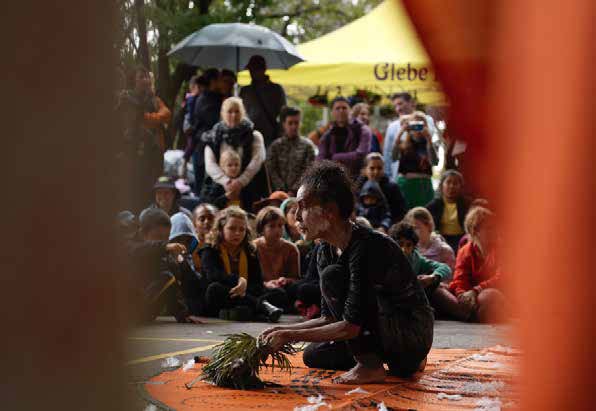
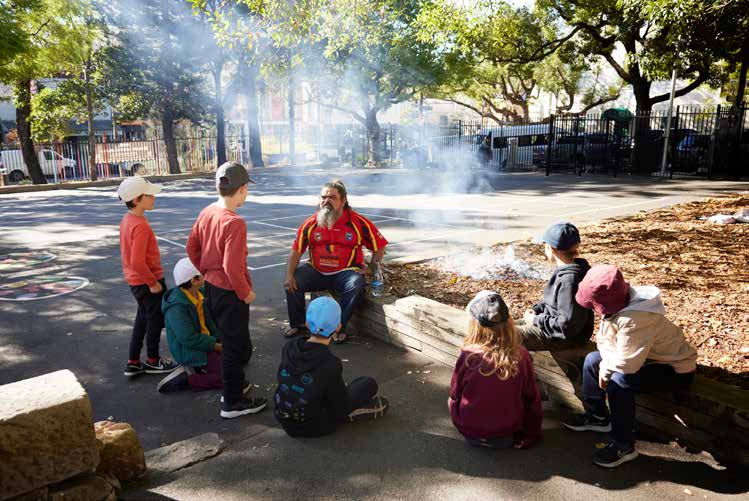
The NAIDOC Community Day has been held at Glebe Public School for over fifteen years. On the last Friday of the second school term in July, the grounds that run along Glebe Point Road become filled with students darting between market stalls facilitated by local businesses and larger organisations keen to have their impact on a grassroots level. The day revolves around a series of speeches, songs performed by local artists and others invited from afar; a smoking ceremony to initiate proceedings, and dance rituals carrying ancient ties to this land.
Helen Michael runs Glebe Tree House, a childcare service operating out of Glebe Public School. She has supported the operationalisation of NAIDOC Community Day for the past two years.
“The event is based on school premises within school hours,” she says, “but it is open to the general public. We had about 1,400, maybe 1,500 visit this year, and about a thousand the one before.”
In 2025, Helen says, “there was about 50 partners, but the main ones I would say were Bunnings, Officeworks, City of Sydney, SAGE, Glebe Youth Services, St John’s Church (Scarred Tree) and we had some local businesses such as, Addy Road, so many medical centres and local services. And the Oz Harvest gave us beautiful soup made there on their food truck. The school set up a petting zoo. And there was Pottery making from Mission Australia. The local member for parliament, Kobi Shetty was there… it’s just a beautiful thing to be a part of. We’re so lucky to live and be part of a school that hosts so many Indigenous students. We have one of the highest percentages in the state—25% of our enrolments are Indigenous students. And the school does a really good job at promoting cultural safety and cultural advocacy.”
While the day marks a special point on the Glebe calendar, Aunty Kath emphasises the efforts required year-round to make the day what it is and urges the significance of holding it at the school.
“It’s not just that particular day of the year or week. It’s about the involvement of Aboriginal education right across the board, and learning. You have really incredible people who are from different parts of the land. We all come from our own belonging areas, but we all work together as a community, and you’ve a big family here in Glebe. The NAIDOC committee is so important, and they’ve done so much over many, many years.”
Aunty Sharon Minniecon and her daughter Larissa, who now chairs the committee, have been a crucial part of Glebe NAIDOC for ten and seven years respectively.
“When Mum came on board,” Larissa says one morning, “it started extending to this place, to St John’s—or Scarred Tree. If you notice, there’s a Scarred Tree just outside,” she says pointing out the front window to the towering tree looking over us.
“That belongs to the Gadigal Mob. Dad (Pastor Ray Minniecon who founded Scarred Tree Ministries) calls it The Sentinel— the thing that is actually guarding this community, reminding this community that our mob existed. The Scarred Tree offers a great metaphor of our people still surviving with the scars of invasion and colonisation.”
In the past decade, Glebe NAIDOC has become a major aspect of their work. With Aunty Sharron and Larissa joining the Committee, the scope widened for Glebe NAIDOC’s annual program.
“We went from like two events to about five events. I think there was a bit of momentum and excitement around what Glebe NAIDOC was doing. I think our biggest event that we ever did was for our Elders.”
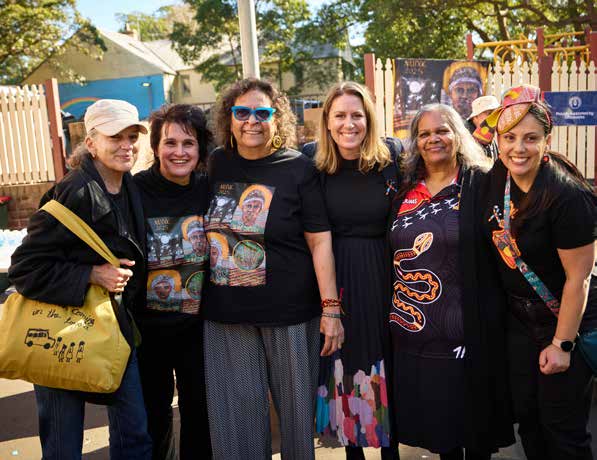
NAIDOC’s official theme for 2023 was “For Our Elders”, celebrating the invaluable knowledges carried by the guiding spirit of First Nations Elders throughout the country. Nagarluma Kariyarra and Yawuru artist Bobbi Lockyer wrote along with her official NAIDOC 2023 artwork (shown … ) that; “Where there is knowledge there are our Elders. Our Elders paved the pathways for us, taught us our knowledge, our history, they passed down their art, stories and wisdom. Our Elders are the foundation of our communities and role models for our children”.
The Elders lunch at Sydney Opera House, Larissa says, “came out of a workshop there. I was mentioning that we wanted to do something collaborative. And I said that we want to put a light on our Glebe Elders. So we invited Elers from Woolloomooloo, Redfern , Glebe, and some Marrickville Elders. It was a fantastic event”.
Another valued addition to Glebe’s NAIDOC celebrations in recent years is the cultural tours coordinated by Scarred Tree. The tour begins with a smoking ceremony at Bicentennial Park before the bus carries attendees through the culturally rich streets and spaces that reflect Glebe’s Indigenous legacy.
“We wanted to build that that tour up a little bit and document our history. During the week of Glebe NAIDOIC, it’s free.”
Aunty Sharon reiterates the importance of the Community Day at Glebe Public School and states how special it is “to see all the kids happy and doing their dances. And keeping our culture alive. Aunty Wendy (Buchanan) is amazing. She’s been really great. And helps, with the children and with the band. And Liz (Lecoanet) runs the school choir”.
In 2025, the school choir performed a song titled Tracks. The song was composed by Liz with words written by Aunty Kath in dedication to Glebe’s Aunty Barbara McGrady (the main feature of our previous issue). It was a heart-warming gesture of appreciation for one of Glebe’s beloved Elders, performed by the community’s next generation of leaders, teachers, Aunties, Uncles, Elders and allies. It was also a potent symbol of NAIDOC’s official theme for 2025: The Next Generation: Strength, Vision and Legacy.
2025 was, however, by no means an easy year for the Glebe community. The NAIDOC Committee were deeply impacted Sorry Business, and extra sensitive to the wellbeing of each other and the broader community. This meant a scaling back of initiatives to allow space for healing, reflection and togetherness.
“You should take time to reflect on what’s important and what needs to be prioritised,” Larissa says. “Glebe’s gone through a lot, but we thrive and we survive and that’s just the Glebe motto really. if it’s not Sorry Business, then it’s issues with housing or issues of homelessness or just cost of living. And as Glebe NAIDOC, through our connections and our collaboration we look to continue that all year round—to thrive and to survive.”
As our conversation comes to close, Aunty Sharon reaffirms this community’s unique strength in its vital and lasting connections: “It’s one of the best communities that I ever worked in, on how we all work collaboratively. That’s what I like, is how we all come together, and respect what each other is doing. I really, really love the way we work through NAIDOC. It brings us together.”
“It’s not just events,” Larissa adds finally, “it’s also our own spirit, our own spirituality—keeping our culture alive… how do we keep creating opportunities to flourish in the midst of history?”
The question seems to be what paves the path forward—beneath the vast branches of The Scarred Tree; through the sacred smoke of burning Eucalyptus; into the open-doors of the Youthie; down Glebe’s streets and alleyways guiding us back more than 65,000 years, and finally—out onto the school grounds in July of each year ahead.