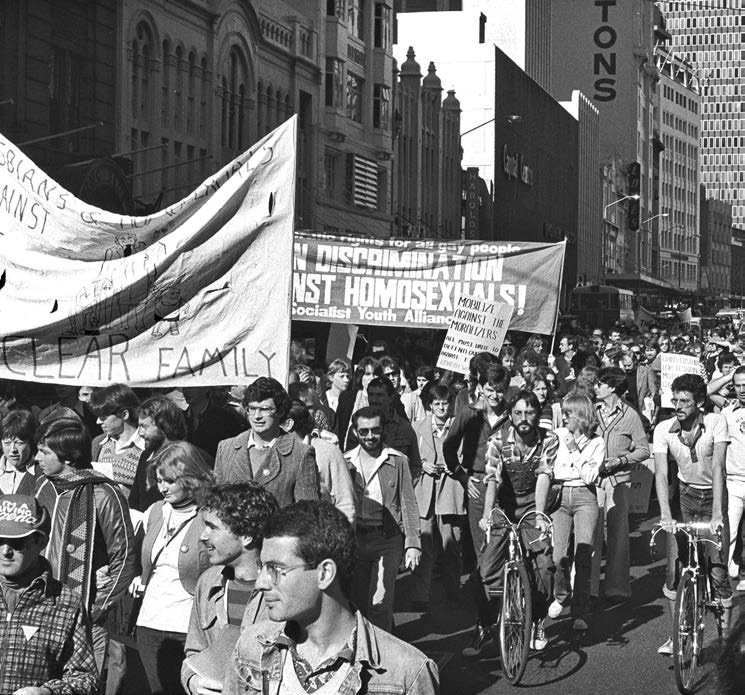
It’s been 47 years since Sydney’s inaugural Mardi Gras parade. On the 24th of June 1978, thousands marched down Oxford Street, demanding the recognition of gay rights and an end to the country’s long and violent legacy of homophobia. What began as a peaceful morning protest later became a street party, but simmering tensions eventually erupted into violent clashes between protesters and the authorities. The police would justify their infamously brutal response behind the repressive Summary Offences Act, which criminalised public assembly and ‘offensive’ conduct.
A lesser-known aspect of Mardi Gras’ legacy is that the parade was imagined in the heart of Glebe. Throughout the 1970s, in the years leading up to that historic night, Radical Glebe became a hub for queer activism, home to several pivotal organisations whose ideas and actions often took shape along the politically charged stretch of Glebe Point Road.
Pride History Group is a Glebe-based organisation working to preserve Sydney’s LGBTQ+ history. In November 2024, the group celebrated its 20th anniversary, marking two decades of communityled archival work and intergenerational storytelling.
Run entirely by volunteers, Pride History Group has collected more than 100 interviews with LGBTQ+ people, covering topics such as early activism, Mardi Gras, community diversity and the HIV/AIDS epidemic. Dr Shirleene Robinson, President of the Pride History Group, says preserving queer history is deeply personal and politically important.
“I think it has been very easy for a lot of our history to feel as though you’re alone,” she says. “People need to understand that homosexuality, transgender people, gender diversity more broadly and people with intersex status – they have long histories, and we should talk about them.”
“People need to understand that homosexuality, transgender people, gender diversity more broadly and people with intersex status – they have long histories, and we should talk about them.”
The organisation has received inquiries and messages of support from people around the world, a reminder of how meaningful LGBTQ+ history can be in places where queer communities remain under threat.
“Just seeing that and connecting with that history, that resistance and hearing people’s voices is very special to them,” says Shirleene. “I think it’s really important to talk about our history.”
The Campaign Against Moral Persecution (CAMP) Inc was first established in 1970 in Balmain by John Ware, Christabel Poll and their partners. The group formed in the wake of similar gay rights movements in the United States, drawing particular inspiration from New York’s Stonewall Uprising. In the early hours of June 28, 1969, police raided the Stonewall Inn, a well-known gay bar. After years of discrimination and mistreatment by authorities, the patrons fought back. With growing support, they resisted six days of brutal police violence in a defiant stand for gay rights. The uprising marked the beginning of a global movement for LGBTQ+ rights.
CAMP Inc was the first gay rights organisation to be established in Australia and would slowly grow to include branches all around the country. In 1973, the organisation moved to Glebe, where they established the ‘Phone-a-Friend’ service. On the 13th of April, a core group of activists met in the living room of 33a Glebe Point Road to christen a black rotary phone “in the name of Jesus Christ SuperStar” (as told in the Phone-a-friend newsletter from April, 1973). The phone was thereby named Paf. Over the next few years Paf would receive around 5000 calls from queer people experiencing the pressures and pains inflicted by a society weighed against them; looking for some friendly, “amateur” counselling and important information about safety and support systems. The ‘Phone-a-Friend’ service continues to operate to this day.
Eventually, it was renamed to the Gay and Lesbian Counselling Service and now operates through Newtown-based LGBTQ+ organisation Twenty10.
Just 150 metres down Glebe Point Road, the house at number 67 was originally home to Sydney Women’s Liberation, a feminist collective that campaigned on issues like reproductive rights, equal pay, and protection from gendered violence. In 1972, the group relocated elsewhere in Glebe, yet the site became home to another activist movement: Gay Liberation, which had emerged out of CAMP Inc. Gay Liberation represented a generational break from CAMP by younger queer activists who considered the former organisation somewhat conservative compared to their own politics.
One of Gay Lib’s methods of protest were actions known as ‘Zaps’. Originating in the queer activist movements in the United States, Zaps were a form of spontaneous and surprising protest, designed to disturb the status quo. They’re marked by creativity, often resulting in cheers and chuckles from members of the public, or creating shock through sudden confrontation.
In an interview with the State Library of NSW, Terry Batterham reflects upon the Zap ethos within the protests of Gay Lib during the 1970s. He recalls one instance when a group of activists scaled the busy escalators of David Jones on Sydney’s Elizabeth Street, chanting “Ho! Ho! Homosexuals!” to the shock and amusement of the large crowds carrying out their annual christmas shopping. So how did these queer organisations in Glebe come to start Sydney’s Mardi Gras?
In 1978, Ron Austin proposed holding a night-time street party along Oxford Street to celebrate queer culture and activism. Fellow CAMP member, Margaret McMann embraced the idea.
“Ron, we’ll call it a Mardi Gras!” she declared.
As retold on the 78ers website, First Mardi Gras, a small group of activists, known as the Gay Solidarity Group, “sprang into action” to prepare the event, creating banners and posters, organising police protests and hiring a truck.
On the morning of June 24, 1978, a peaceful protest took place at Sydney Town Hall, demanding action against discrimination faced by queer people. Meredith Bergmann, a Glebe resident for over 50 years, remembers attending the march.
“It was about trying to stop the police attacks, and particularly the police were trying to stop the reasonably new elected Labor government from abolishing the Summary Offences Act,” says Meredith.
“Our slogan as we marched up the street was ‘stop police attacks on gays, women and black people’ and so it was about the fact that the gay and lesbian community and that Aboriginal Australians were being hassled and often attacked by police.”
But it was later in the evening where the crowd came together, with 2,000 participants taking part in the first Mardi Gras, the first time members of the LGBTQ+ community in Sydney had gathered together on the streets to celebrate their queer identities.
While the morning protest was peaceful, the second gathering along Oxford Street rapidly escalated when police intervened. Officers began making arrests under the Summary Offences Act, and the night turned violent as participants were beaten and dragged into police vans. The brutality shocked many and marked a turning point in Sydney’s queer rights movement.
“I’d gone home and I was rung up and rushed out, I ended up bailing out a lot of the people who had been arrested on that day and particularly Peter Murphy had been very badly bashed,” Meredith recalls.
Peter Murphy was one of 53 First Mardi Gras protestors to be arrested that night in June. Following his arrest, Peter was brutally bashed and assaulted by officers, suffering bruising to the skull, ribs and kidneys, and a concussion.
“He [Peter] was a friend of mine, so I took him to St. Vincent’s Hospital and then to a doctor friend of mine in Glebe, Paul Torzillo. And then this was all early in the morning by this stage,” says Meredith.
“And then I took him to another friend because he wanted legal advice about what to [do]. He wanted to sue them. And that was also in Glebe. It was Pat O’Shane, who later became the first Aboriginal magistrate.”
Today, much work is being done to preserve the queer history in Glebe. Meredith recalls living in Glebe during the 1970s, alongside Heather Goodall, and Helen Randerson.
“It was very exciting. There was lots of squatting, because there were two great expressways that were going to bisect Glebe. So a lot of the houses that were in the way of the expressway were left to become run down by their owners and were being rented out for very, very low rent. The expressway didn’t come through in the end, but because of the squatting and the cheap rent for students, it allowed lots of radical activity to happen.”
The three women are now writing a book titled ‘Radical Glebe’, which will be published later this year.
“We moved in ‘68,” Meredith says, “and we had a sharehouse for a while before we went off and had babies and everything. So the three of us have lived in Glebe for 50 years, and we remember the radical Glebe of the 60s and 70s.”
“So we wanted to write about it because it was extraordinary.”
For Shirleene, much of Pride History’s work involves recognising the efforts of those who came before. “These have been long fought battles, but recent battles,” she says. “So I think that every younger person who interacts with an older person should be mindful that, in some ways, that history carries a weight, and it is something that people carry with them.”
To mark Pride Month this year, Pride History Group is hosting ‘The Great Pride Debate’ on June 10 at Qtopia Sydney in Darlinghurst. Historians, academics, writers and activists will gather to discuss whether “LGBTIQA+ history will always be a niche subject.” Tickets are free via the group’s website.
From Glebe’s radical past to its activist present, organisations like Pride History Group continue to ensure that queer history is not just remembered – it is lived, shared, and carried forward. Glebe’s legacy as a cradle of queer resistance lives on through the people and organisations still fighting to preserve its history, ensuring that the struggles, triumphs, and voices of the past continue to shape the future.