For a long time in this country, youth work was approached as a way of “saving” disadvantaged young people, imposing top-down assumptions of knowing what’s best onto unique communities—often against their will. The damages of these approaches have been vast—uprooting adolescents and detaching them from their own, personal stories. The historic injustices experienced by Aboriginal and Torres Strait Islander people have shown just how damaging institutional arrogance can be. Social work, especially for young people, has long failed to appreciate the unique potential of individuals within vibrant communities like Glebe, and in many state institutions—the damage continues.
The youth work sector has since changed its ethos to one of empowerment, participation, and human rights. Yet, these sentiments are mostly left to be upheld by non-government organisations—such as Glebe Youth Service—that are nevertheless dependent upon government funding to survive. But what does this approach look like in practice? How can these ideas be realised on the ground-level? And how can institutions recognise the diverse qualities of less privileged communities, with unique histories of struggle that have forged their very own particular strengths? The most fruitful approaches are likely to come from those who have experienced their own battles—the ones who grew up on the same streets, alongside the same families, who’s younger ones they’re now guiding through similar weeds of disadvantage.
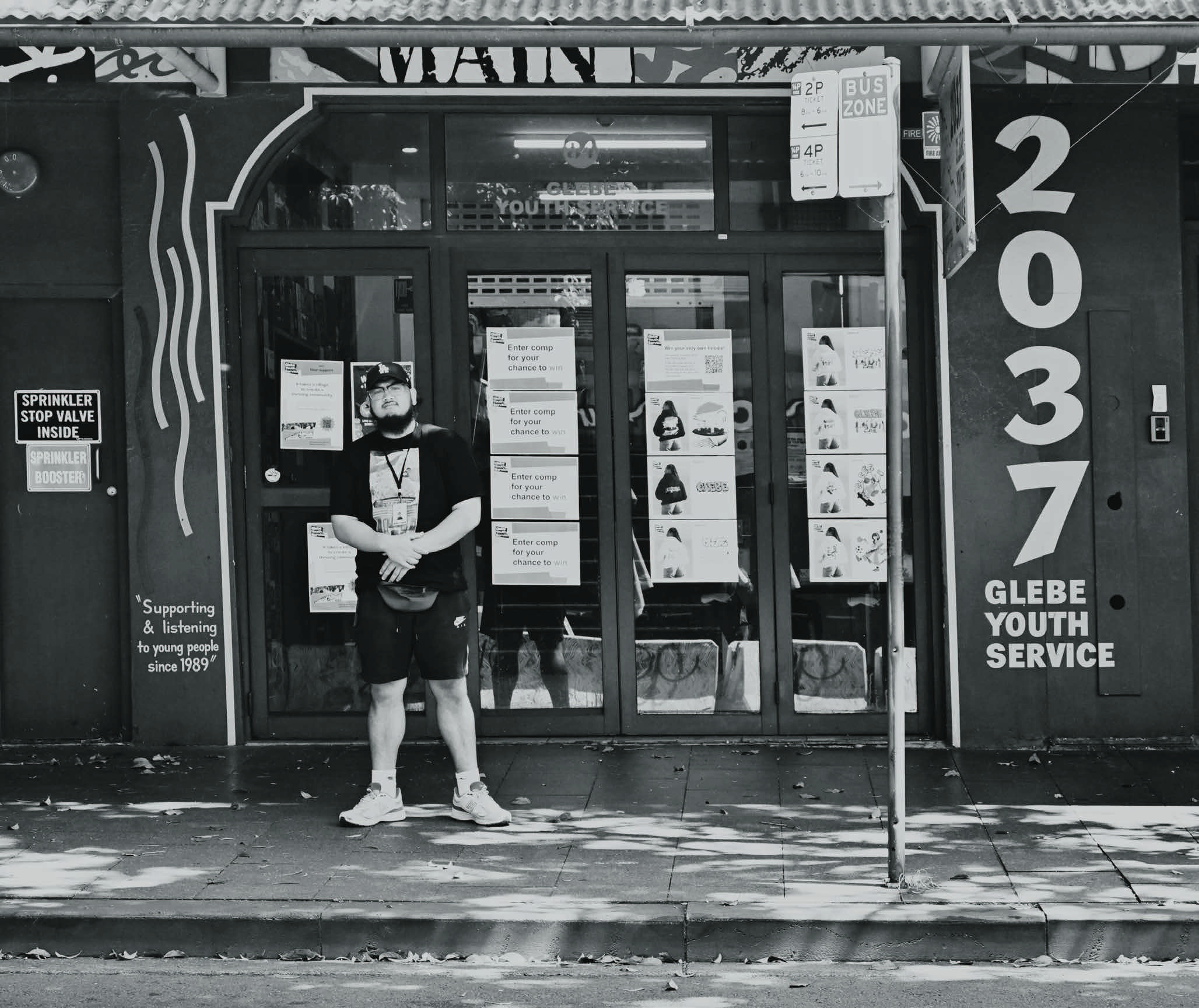
Standing outside the double-doored entrance of Glebe Youth Service (GYS) is one such man—over six feet tall, wearing a yellow hoodie, football shorts, black Nike sneakers, and squared prescription glasses resting over a bearded grin. The streets are quiet for mid-Thursday—just a steady September drizzle hitting the concrete of the near-empty footpaths—and the odd bus growling up Glebe Point Road towards the northern harbourfront.
Habil says he’s tired but doesn’t seem it—he’s cheerful and welcoming as usual. Rarely a sentence ends without a quip of sarcasm. This same energy springs across the road when a young man half his age shouts “Habil!” from outside the kebab shop. It’s a routine back-and-forth from the Youthy entrance out to the streets that he’s walked for most of his 30-year life.
He moved to Glebe when he was 6 years old with his two older brothers, and parents who had migrated from Indonesia in the early 1980s. “My parents made sure that I had religion and culture embedded in my morals and values,” he says. “I keep my Indonesian culture close to my chest”. A lifelong devotee of the Islamic faith, he considers it “a rulebook for life”.
Habil began his time at GYS towards the end of primary school: “I came to some programs,” he says, “they used to have a Wednesday Oz-Tag program. I used to go to the Peter Forsyth Auditorium to play touch footy”. Looking back nearly twenty years, he says, “the older boys used to take care of the younger boys. We’d play footy on the road. They’d join in. I remember when it was a hot day, they’d buy water balloons for us and we’d have a water fight. The whole street. They used to have cookouts on the barbecue. Someone would buy meat, and the barbecue would be on Derwent Street, or Mitchell Street. Someone would be cooking up a storm. Everyone didn’t have anything. We all didn’t have anything together.”
After high-school, Habil completed a 100-hour internship at Glebe Youth Service, before becoming an official employee in 2016. Since then, he has worked constantly with young people on the ground-floor. Yet, his mind seems often pointed upstairs, towards the broader system—on the processes of change…or lack-there-of. Habil has observed the system function from below; he’s watched the institutional wheels churn, become rusted and clammer to a halt—before a few drops of political oil can set them in motion again. He has himself grown out of this cycle—it’s given him a critical perspective as a youth worker for the last nine-years.
“The Youthy has always been an integral part of the community,” he says. Though in order to really grasp why, he says that “people need to understand what Glebe is like. You know, it’s not sunshine and roses. It’s a low socio-economic area: trauma—intergenerational trauma.” For many locals of Glebe, he says the youth service “is their second home.”
Habil seems clear-minded about his responsibility, about what GYS needs to deliver, and what his community requires through the thick and (mostly) thin of government funding and support: “If you look at the Maslow Hierarchy,” Habil says, “the basic necessities of a human being are food, shelter, clothing. What do we offer? We offer food, we offer a safe place for them to come, safe humans to interact with. And then if they need, you know, necessities, we do as much as we can to give it to them. And that’s just the basics of what we try and do.”
GYS helps to address these basic needs through their open-door policy throughout the week, where locals can—and do—stroll in for a friendly chat, a word of advice, a kitchen prepared meal or a couch to rest on. Yet, a simple sign of welcome can often go unseen, and so Habil also co-runs the Youth Outreach program alongside Jeff Hockey. “That’s a new thing we rekindled just because of the higher crime rate during the holidays,” he says, “It was for us to go in the streets, pretty much walk around and see if there are any young people around, and then shift them back to the youth service.”
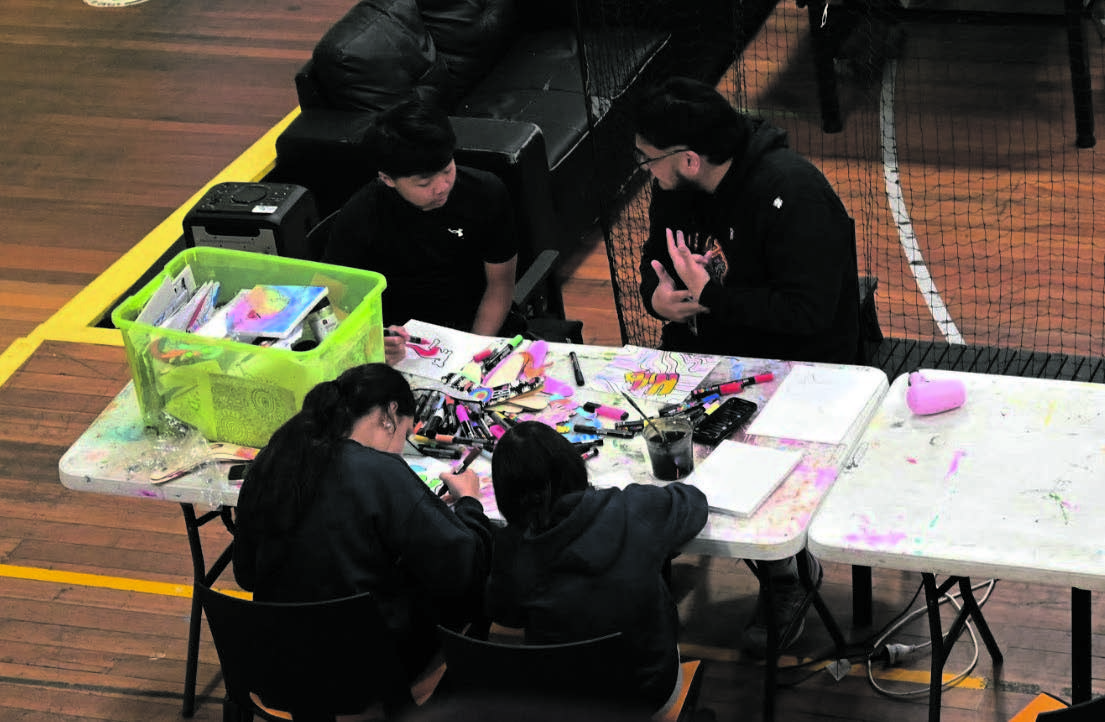
It is a fitting responsibility for someone with such a detailed blueprint of the suburb—engrained through years of lived-experience sitting upon the very same curbsides. Habil knows every back alleyway; the peak hours for push-bike traffic; he could probably map out all the potholes for the kids to avoid, and every fresh trim thrown awry by the afterschool winds. “Everyone has a strength in what they do, like in life or at work,” Habil says, “my work is engagement, being connected to community helps me with that engagement,” Habil says. “That’s my bread and butter. I know your family, they know me, they feel a lot more comfortable.”
On the Youth Outreach program, he says: “when we first started, it was a bit slow, but you just have to stay consistent. One of the nights we bumped into 24 young people, in one and a half hours. And police presence was high. And they just kept stopping everyone, asking for their names. Luckily, Jeff and I were just cruising through and doing our thing. We were able to talk to all those young people—because they were angry: ‘Why are police stopping us? Because we’re black?’ And that’s probably the case. But our role there is to interact with police, ask them what they want, ask ‘is this necessary?’ So as an adult there, that the kids trust, there’s more respect there—that’s how it is. We’re able to shift the police that way and the kids back to the youth service. So, the interaction isn’t a negative interaction. And the police can talk with me and the kids can talk through me as well. Police don’t understand the intergenerational trauma.”
Habil draws constantly from his own lived experience and uses it to inform his everyday decisions as a youth worker. Yet, he sits all of this within a broader picture of systemic failure and its consequences: “Police are part of the system and it’s been like that with the Aboriginal community for so long in such a negative way. So that’s why we try and diffuse the situation as much as we can, but also show the young people that we can interact with the police in a positive way at the same time. So, I’m trying to do two birds, one stone. We try to have a better relationship with the youth liaison (police) officers. We might not agree with how they work, but we have to find a middle ground just to make it work,” he says.
Habil considers his job a “necessity” more than anything. “You don’t enjoy all aspects, but everyone doesn’t like their job all the time. I love the job. I hate the job. I do it out of necessity. And this is my community. I love this place to death. This is where I grew up. This area made me who I am. But you don’t realise how much bullshit First Nations people cop,” he says.
Born out of negative assumptions of police (as Habil explains above), distance continues to evolve between state-institutions and First Nations youth, producing lifelong resentments between both, and deep-rooted discrimination from the top-down. As of June 2023, Aboriginal and Torres Strait Islander people account for 33% of all incarcerated people in Australia. The absurdity of this statistic was heart-breakingly outlined within the Uluru Statement from the Heart in 2017:
“Proportionally, we are the most incarcerated people on the planet. We are not innately criminal people. Our children are alienated from their families at unprecedented rates. This cannot be because we have no love for them. And our youth languish in detention in obscene numbers. They should be our hope for the future.
These dimensions of our crisis tell plainly the structural nature of our problem. This is the torment of our powerlessness.”
“The thing is with intergenerational trauma,” Habil says, “you want to break that cycle. We give them the tools that they don’t have, and then they pick up the tools and use them when they need it, or when they’re ready. And that’s how change begins. We want change, but we’re not superhumans. If a youth worker or social worker comes into this industry and says they want to change the world, then they’re not going to change it. They’re going to get burnt out. You do what you can control. So, my duty is to give the young people and the community the tools so they can build it themselves. Whether it be tools of emotions, tools of physicality, tools of work, tools of financial literacy. That to me is how you break a cycle. Because some of these kids don’t have the opportunity. They might have an opportunity one way, but everything else, nothing.”
As Habil shows, there’s no easy fix to system level problems. Yet, in his time of encouraging change from below, it’s through seeing the positive outcomes that Habil’s flame stays alight:
“I’ve been here for nine years. So, to see the young people that I work with grow up, and they’ve got jobs, and they have careers … that’s the beauty of this place.”