Aboriginal and Torres Strait Islander readers are cautioned that this article contains images and names of people who have since passed away.
Aunty Kathryn Dodd Farrawell is a Kaanju Birri woman who has lived in Glebe since 1972. Her artworks have enlightened the walls, gardens, and public areas of an Eora place rich with Gadigal belonging. She is a community member and friend to locals of many different walks of life, but loves spending much of her time with the younger people of Glebe. In opening our discussion one Winter’s afternoon in the office of Glebe Youth Service (GYS), Aunty Kath reflects upon and acknowledges where it is that we are meeting. “I live on the lands of the Gadigal people,” she says, “and pay respect to their spirit and their belonging in the waterways and everything that was and always will be Gadigal Land”.
Aunty Kath’s artwork is grounded in a sense of responsibility to her lineage, in truthtelling, but it also embodies a celebration of the beauty and belonging of the land and community she holds so close to her heart. “I love Glebe because it is a cultural garden,” she says, “of everyone coming together, foodwise, people-wise, and connections. So, when you come to the Youthy (GYS) and are living around Glebe, you’ve got people that express and walk with their art. Our old people, we express it through the arts. When you see the young people doing their beautiful art, it’s got that inner beauty. It speaks and it expresses, and we have people of all different ages doing it in different forms. We all team together and it all comes together around Glebe. You have the recording studio downstairs. It’s all good fun, and it’s their Voice. I can’t play an instrument, but I love listening to beautiful music. The simplicity of people making music. It’s good medicine. My dad and my brothers would be singing, and my dad would be playing guitar. We had that beat in our heart”.
“When you see the young people doing their beautiful art, it’s got that inner beauty. It speaks and it expresses, and we have people of all different ages doing it in different forms. We all team together and it all comes together around Glebe.”
Aunty Kath’s father, Reg Dodd, was a Birri man, born to his mother Emily on the riverbank of the Bowen River in 1907 (near Strathmore Station) – he is remembered as a fighter for equality, for human rights and justice, and for being a wonderful father. Her grandmother Ruby was a Kaanju woman from the country’s northern point (what’s now referred to as Cape York). Aunty Kath’s mother Kate was from near Cooktown, and her Aunty Ellen was born on Palm Island. Aunty Kath experienced the dawn of her life further south on Darumbal Country. It covers what’s now known as the Rockhampton and Capricorn Coast Area. She was the last born into a family among eight brothers and two sisters.
The Darumbal People live through a belief in oneness, an interrelationship of country, people, with all that exists. This frames their way of life through a complex system of social and spiritual activity. They were first encountered by Europeans in 1853 when two pastoralists, Charles and William Archer came across the land in their travels. One year later the traditional owners were removed by British colonial forces. By 1860 those of the Darumbal people that survived the frontier wars were dispersed onto government- run missions over 200 kilometres away. At the beginning of the twentieth century there remained one hundred recorded Darumbal survivors.
In remembering her childhood on Darumbal Country, Aunty Kath speaks of good, hard working people and fond memories. “We were allowed to be children down at the creek and playing in the mud,” she says, “playing in the sand, always encouraged to sing. It was good fun growing up with my cousins around the tamarind tree. We were encouraged to do art and be who we were and where we come from…even though they (her family) were separated from the culture with the Aboriginal Protection Acts back in the day. There was always fear of children being taken, your family being split up by the authorities. And that’s what they did”.
The Protection Acts were first introduced by the Queensland government in 1897 and reinforced by subsequent amendments in the decades following. The new legislation gave public and private administrators unprecedented authority over the lives of Aboriginal and Torres Strait Islander people. Indigenous agency was legally eliminated, which ultimately led to the wide-spread razing of Aboriginal camps. The inhabitants were removed by men on horse-back using 9 stockwhips and firing bullet rounds above their heads as they were led away to wherever their labour was needed.
(Figure 1.1) portrays her parents who, along with her grandmother, had felt the full consequences of these laws 65 kilometres north of Gurambillbara (Townsville) on Palm Island and removed to Woorabinda Aboriginal Reserve – west of Rockhampton.
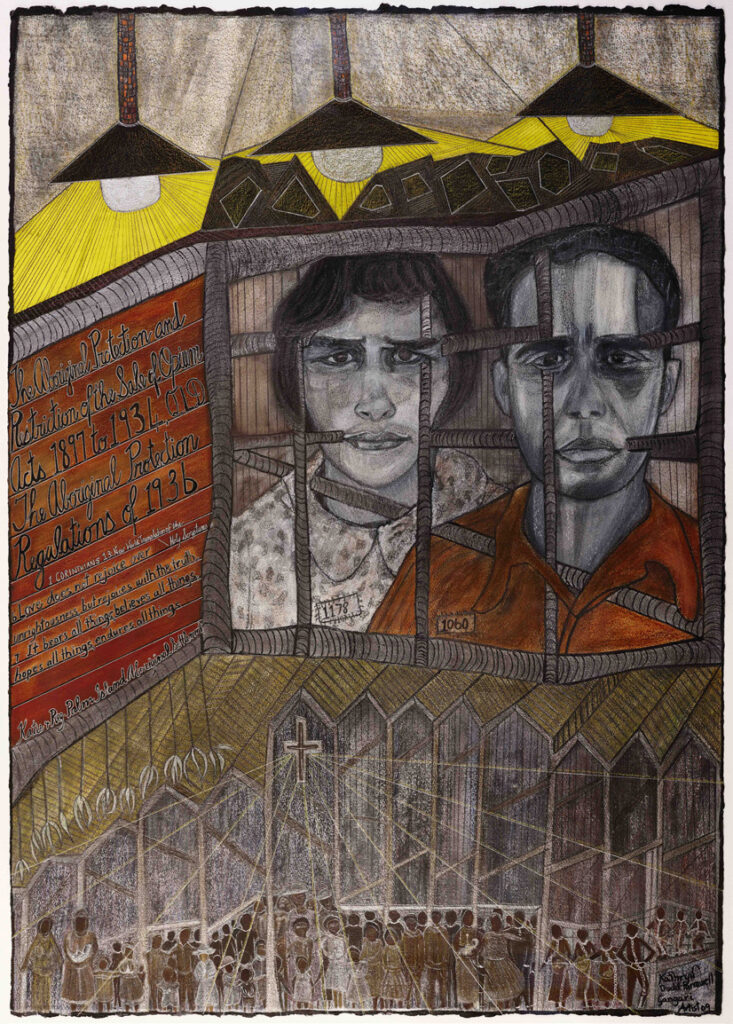
“That’s where mum and dad were locked up under the Protection Acts back in the day…and they were given a number and referenced as a ‘breed’. When I first started doing this, someone said, they don’t look right, those lights, you have to fix up those lights, and I had to fix them up, but this is the light shining on the truth, and they were in chains there. It was a penal reserve. People had no freedom and no rights”.
Whilst often portrayed in the media as an exotic oasis, Palm Island was among the harshest places for Indigenous Australians to be sent by the Queensland authorities. Prisoners were kept to a strict regime of unpaid labour and gestural conditioning under their white subordinators. In the 1930s a local doctor vocally expressed his concern for the malnutrition on the island, demanding that the authorities at least triple the nutritional supplies of the prisoners. This recommendation was denied. Indigenous detainees were banned from speaking their own languages or conversing with white officers.
The Protection Acts and the resulting Palm Island penal reserve embody critical yet not isolated junctures in the history of colonial injustice towards Indigenous Australians. The remaining wound is still felt by descendants, as can be seen in the artwork of Aunty Kath. Her work has embodied the struggles of her family, her friends, and First Nations people throughout her lifetime – from a local focus on her home in Glebe, to a countrywide commitment to truth-telling and Indigenous acknowledgement by the punitive settler political system. “You still see it through the intergenerational trauma of Mother Earth and her children today,” she says.
“Sometimes it is your Voice coming out. Sometimes it’s a way of connecting people, and sometimes it’s a gift back to people, to recognise them.” When asked about her creative process, Aunty Kath says “You might not have anything one day, or the paintbrush might not be calling, but then all of a sudden, it happens … With the Voice referendum, I felt that doing some art and expressing through words – I don’t call it poetry – but it’s having an expression, not in big words but in your words and listening to your music. When we were in Brisbane, my niece and I went on the march, and there’s about 20,000 people there, and it’s a sea of grey hair, and Yes t-shirts, and we said, who would have thought?”. The artwork displayed in (Figure 1.2), and the message of hope held within it, was painted by Aunty Kath during the national referendum for an Indigenous Voice to parliament. “I pulled the old hair out of my hairbrush to paint this,” she says.
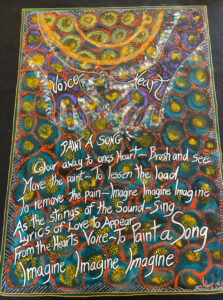
(Figure 1.2) 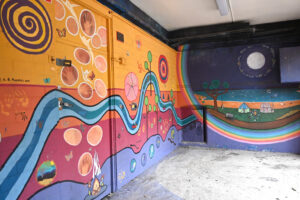
(Figure 1.3) 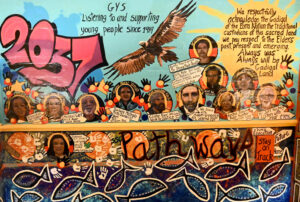
(Figure 1.5)
Aunty Kath now dedicates much of her time towards passing on her knowledge and creativity with younger ones. Regularly doing workshops out of Glebe Youth Service, she sees the light of imagination in younger people, and in creating and making art for and with community. “It’s more like a family I think that comes within Glebe,” she says, “You see the young ones growing up and you see their talents and you know they get in there and do it. There’s some other beautiful people that encourage them to paint and having a space that’s provided for that to happen too is important”.
zAunty Kath speaks in tones of respect and admiration for her fellow Elders and artists that have helped plant the good seeds of Glebe’s flourishing. “There was another beautiful artist that lived in Glebe,” she says, “and that was Aunty Elaine Russell,” she says. Aunty Elaine was a Gamillaroi painter and illustrator. She was born in 1941 on Nucoorilma Country, in Tingha of Northern New South Wales. Aunty Elaine’s artworks depict the memories of both light and sadness that are tied to her upringing on the Murrin Bridge Mission. Since the 1990s Aunty Elaine became an integral part of the Gadigal, and especially of Glebe’s creative community. “She is and always will be an amazing artist,” says Aunty Kath. “If you get a chance to look up her artwork, and her books, she’s an amazing world-famous artist. Aunty lived in Glebe, and you look at the colours she used…they were her stories of belonging”. Over three weeks in 2011, The River Song Mural (Figure 1.3) was created in the canteen area of Glebe Public School. It was designed by Aunty Elaine Russell who also painted it with the help of Liz Rooney, alongside many appreciative young students.
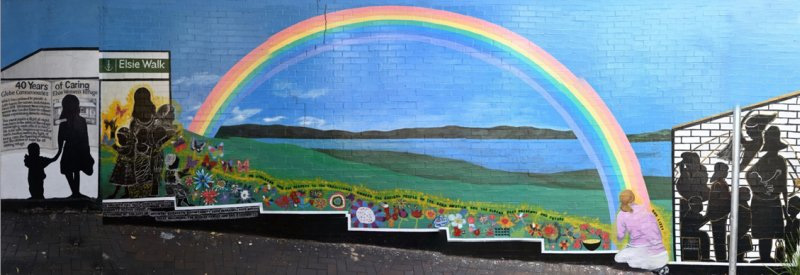
Several years later, another art project was created along Elsie Walk, bordering Glebe Public School. It was coordinated by Liz Rooney and painted with the help of Aunty Kath and other community artists, young and old. “Our beautiful Lizzie was organising that over a long period of time with the rainbow,” she says, “It was for Elsie’s Women’s Refuge at the school. It was the forty-year celebration of it being open”. In paying a deep respect to her legacy of warmth, nurturing, and creativity, Kate Brennan and Liz’s sister Emma Rooney collaborated to paint an image of Liz, at work on the mural, into the mural itself. Liz’s loving family also helped to complete the mural (Figure 1.4). “Our Lizzie is kneeling and painting her beautiful rainbow of love, hope, promise and equality for all,” Aunty Kath says.
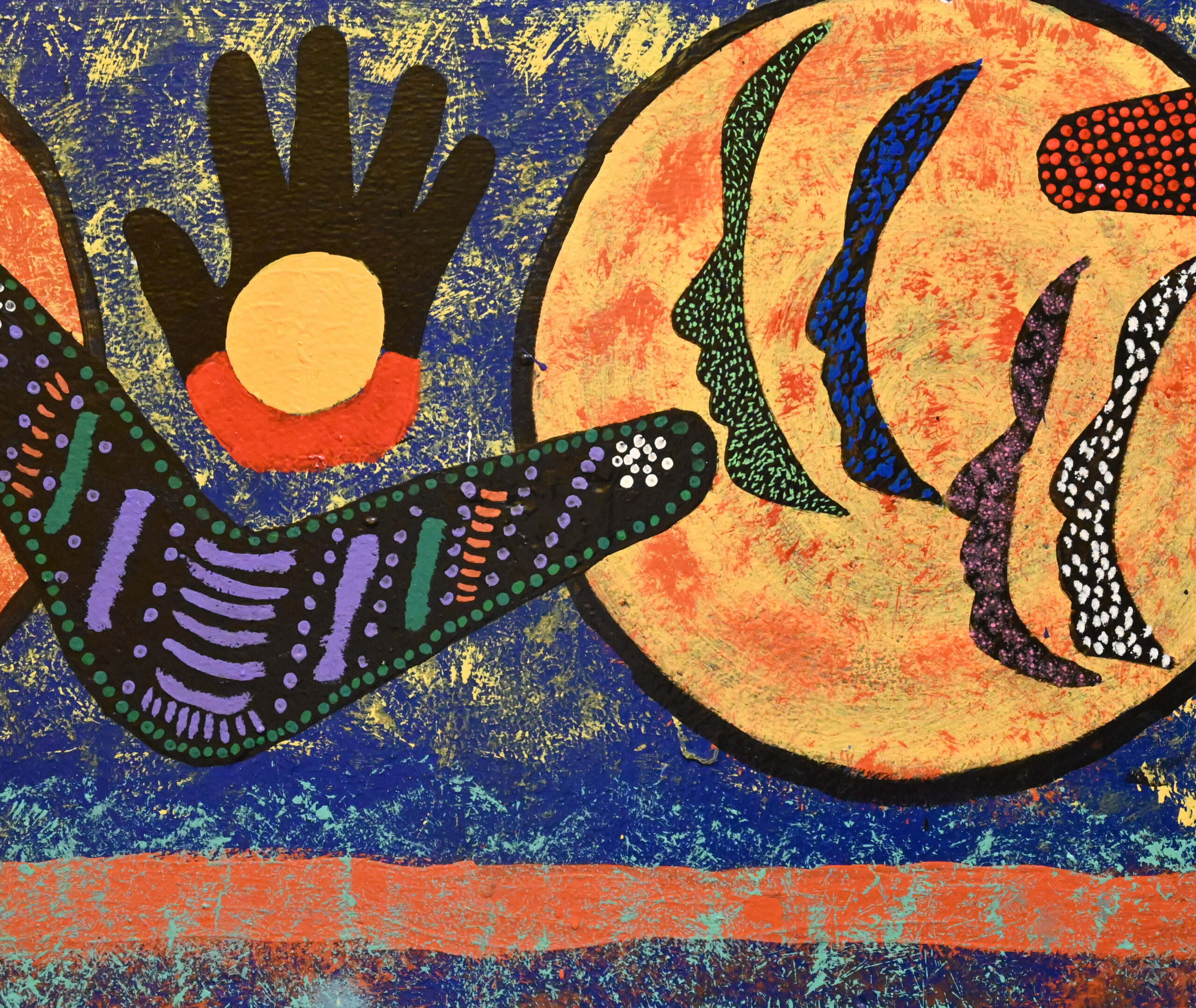
Community artworks have been shown to tell stories that engage local communities in discussions grounded in truth-telling and a collective spirit. Often regarded as a form of ‘counter-storytelling’, artists share knowledge with their communities, portraying realities often not told in the broader public conversation. Artists such Aunty Elaine, Aunty Kath, and Liz Rooney, help to create tracks across cultural fractures and untruths. This also strengthens connections between generations: young and old come together in a mutual sharing of teaching and learning. This can be seen at its full potential on the walls of the studio space at Glebe Youth Service, where in 2020 Aunty Kath and young artist Georgia Frew coordinated a mural that was painted by locals young and old (a section of which is shown in [Figure 1.5]). It is dedicated to Glebe’s powerful lineage of leadership and inspiration, as well as a homage to First Nations legacies across the country – past, present, and emerging. Always was, always will be.
“That’s why the Youthy is really important,” Aunty Kath says, “and things can come about. And you say to young ones, just be yourself, do your own. That’s what you’re about – how you put down and you make your shapes or how you want to do it. And you learn as you go along with the process in different ways. You grow up and it’s where you live and who you are, and who you relate to and who you belong to in your community, and in your belonging country”.
“Everyone has a Voice, yeah, a way of projecting. They know themselves; they know they’re talented. Sometimes it is your Voice coming out. Sometimes it’s a way of connecting people, and sometimes it’s a gift back to people, to recognise them, and for people to understand, you’re all right, you can do it, yeah, we can do things together, there’s a remembering of the old people we belong to, and as I said, there’s a connection. A deadly red, black, and yellow connection to Mother Earth”.