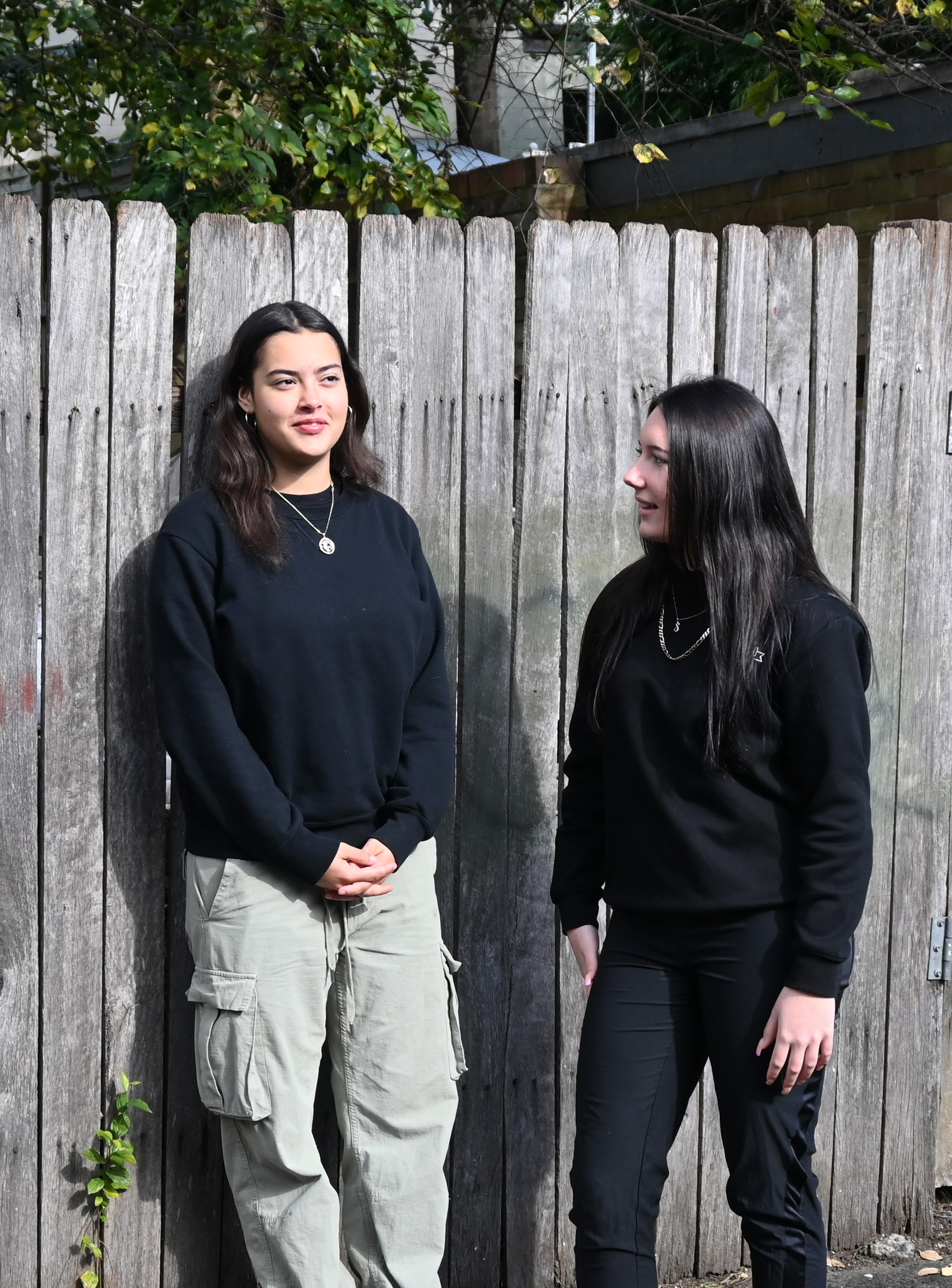
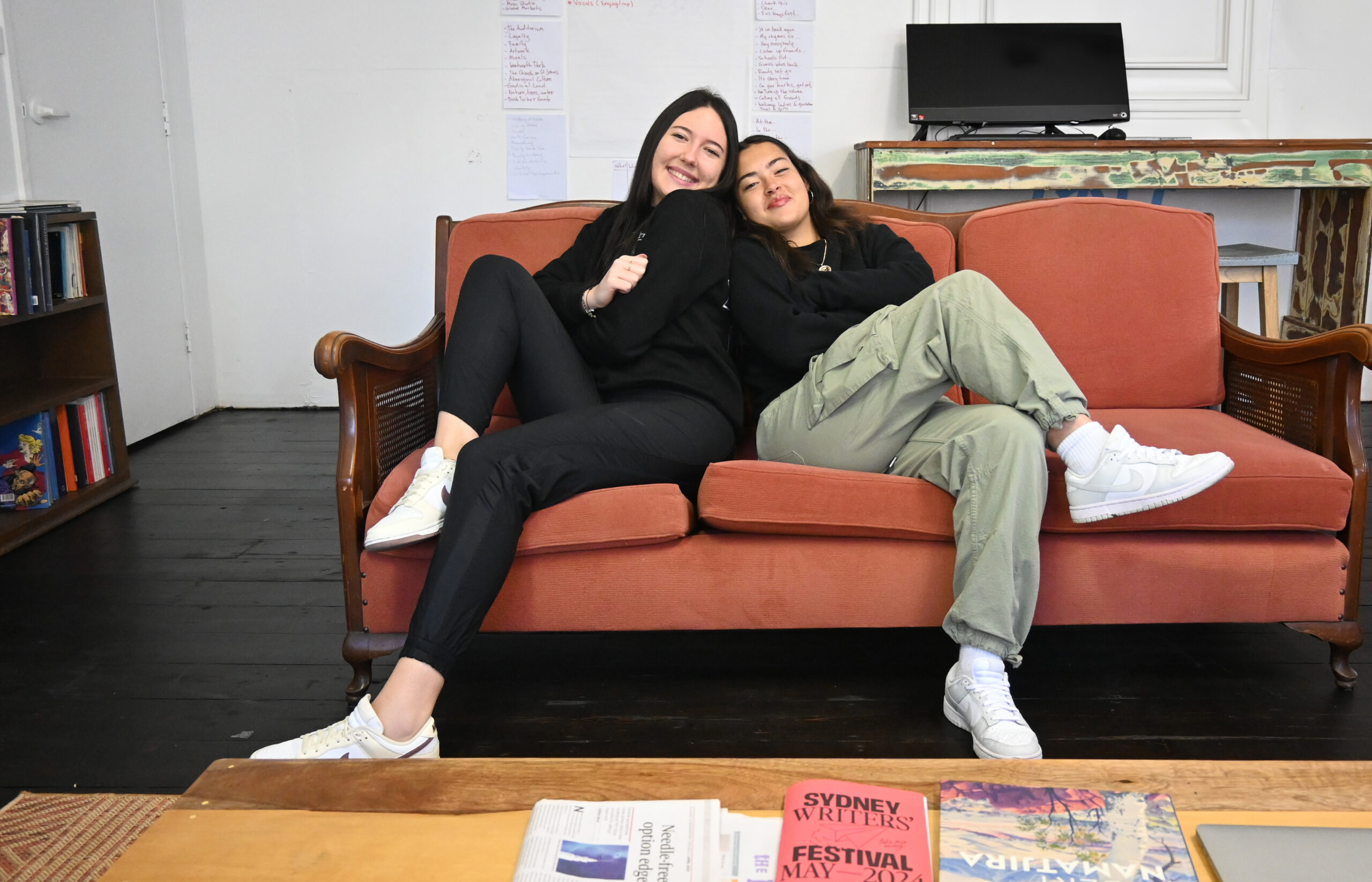
It’s a Monday evening at Glebe Youth Service and Mali and Sarah are sitting alongside each other. They seem at ease, with a calmness of being at home. The building is filled with the laughter and screams of about a dozen primary school kids unleashing that uniquely powerful force of after-school energy.
About an hour ago, we all sat around the stereo monitors in the half-office, half-music studio, listening to a new song created during the after-school program. They all chanted the choruses together whilst individually adding their own lyrics to the verses over a well-polished hip-hop beat. There was a refreshing honesty within each phrase that only children could bring. It really sounded like a hit.
Seventeen-year-old Mali was involved in guiding the production process. “I’ve always been into music’ she says, ‘I knew I wanted to do music, but I didn’t know where…I started coming here every week and then I did a little course with people teaching me how to use the room … and then I just started using it”. She’s now employed tutoring music production for Nakama Arts – an organisation focusing on collaboration and enhancing creativity throughout the country. In partnership with Glebe Youth Service, they started ‘Studio 37 Open Studio Sessions’, a two-hour workshop session every Wednesday afternoon from 3:30pm at GYS. Mali went through the program herself in recent years before being officially brought onto the team. Her influences run impressively deep into the hip-hop lineage and beyond. “In terms of rap: J. Cole, Drake, Brent Faiyaz … I like a lot of old school as well like Jay Z, Biggie, definitely Biggie, Lil Wayne, Aaliyah, Sade”.
Both girls grew up in Leichhardt and attended high-school together. They started coming by the service during their early teenage years after hearing about it from friends. Sarah has just walked up the stairs from helping manage the joyful chaos below. She is studying her Certificate IV in youth work at TAFE and is completing her placement hours at Glebe Youth Service – the place she knows best. When asked why she wanted to do youth work she says, “it became a massive passion when I grew up around here. Family stuff, just experiencing how kids feel and act. Obviously, life isn’t easy for everyone, and it’s really cool to know how to support children, the best way that you can. I went to TAFE and thought I’d try it out and see what I can do. And I loved it. I loved the theory work. The only theory that I’ll do.” she says laughing.
There’s a passion in Sarah’s voice which suggests that this line of work is choosing her as much as the reverse. You can hear a fierce sense of social responsibility that seems representative of her generation. But she also appears grounded in a realistic, grass-roots outlook, usually observed in the lived experience of well-versed social practitioners. “I think kids need heaps of support,” Sarah explains, “they need the most support they can get. Whether it’s joining a sport team, doing music like Mali, stuff like that can completely change the way that kids think and feel and act. Just being there, listening. They need to people to hear them.”
Her knowledge and perspective have been shaped by her years in this very building. She learned from her mentors, who strive to connect with anyone wandering through the entrance, up to the basketball court, or further back to the kitchen for a free meal often cooked by Habil, a respected youth worker, chef, friend, and long-time guide to many. “You hang out, you chill, you’re with your friends,” Sarah says, “People who you are comfortable with. You learn about stuff that you wouldn’t really talk about at school. We talk about culture. 70% of the people that come here are Aboriginal. So, you learn more about them. You learn about the Elders, the aunties, the uncles. Habil has been around for ages, he’s cool, you know? And the boys and girls, they come together so well here. But outside, you just do your own thing. You can just do whatever makes you comfortable and happy here and when it’s time to go home everyone’s like nooo I don’t want to go yet”.
To this, Mali agrees. There’s a sentiment of security – of connection to a larger family. You get the feeling that it’s one they are proud of. “It just felt like a great space to come after school,” she says. “It felt calm and safe, and you could have a feed. And as you get older… I’d rather come here on the weekend than do other things. I’d rather come down here and see everyone… As an only child, I’ve never had many people my age around me, and this was a community I was comfortable in,” Mali says.
They both speak earnestly about their time here. The felt connection to community runs deep and has provided them with important skills and passions that now light-up the path ahead. They seem excited about the future, without feeling the impending pressures of time so common to those reaching the end of high school. “I want to work for a bit,” Sarah says, “go into the industry and think and see if this is something I really want to do. I have the rest of my life. If that’s something I really want, I’ll go straight to uni. But I definitely think this is something I really want to do.”
Regarding her future in music, Mali adds, “I want to make a fulfilling career out of it. I want to make music that I genuinely enjoy. And work with people and just… make music”.
“Something that I’ve learnt through music, and through coming here is that, as funny it sounds, it starts within. And especially if your home life isn’t feeding that to you from a young age, in the developing years, if you can’t source within, you’re not going to be able to source externally”
The combined insights of both young women show the importance of youth services. It displays how places like this provide communities with the foundations to come together in times like ours, when connection seems more difficult to nurture against the isolating effects of modern technology and a global pandemic. Mali emphasises the importance of young people finding themselves within a community and, through drawing upon her own experience, describes how creativity can offer such a path forward: “something that I’ve learnt through music, and through coming here is that, as funny it sounds, it starts within. And especially if your home life isn’t feeding that to you from a young age, in the developing years, if you can’t source within, you’re not going to be able to source externally, that’s why kids are so easily turned to drugs and stealing or whatever it is, because it gives them a satisfaction externally that they’re not getting within. And with music, I think it’s great to have that kind of expression and you can start to feed whatever’s within, to something external, and you can build a better relationship with yourself. And then you can start to look at beneficial things and positive places to go and you can give yourself the ‘I deserve it’, or ‘I want it’
The experiences of Mali and Sarah, both now soaring towards adulthood, teach us how we might build a stronger sense of connection for young people: it comes from those closest to the ground, from community – from within.